ISNA Convention seeks to nurture compassionate communities
The Islamic Society of North America (ISNA) held its 47th Annual Convention over the July 4th weekend in the Rosemont suburb of Chicago, Illinois.
Thousands of Muslims from across North America and the globe convened in one place to celebrate this year’s theme, “Nurturing Compassionate Communities: Connecting Faith and Service.”
ISNA Secretary General, Safaa Zarzour, expressed deep gratitude for all who made this year’s convention possible.
“We are so thankful to all who attended this convention, all the volunteers, the wonderful Chicago community, and the Council of Islamic Organizations of Greater Chicago.”
Hotels in the area were sold out due to high demand for the ISNA Convention and local, national and international media traveled to the convention to share with the world the message of compassion and community service echoed throughout each of the more than 100 convention sessions and special events.
A press conference held early Friday afternoon was attended by most major Chicago news channels, including ABC, NBC and Fox News.

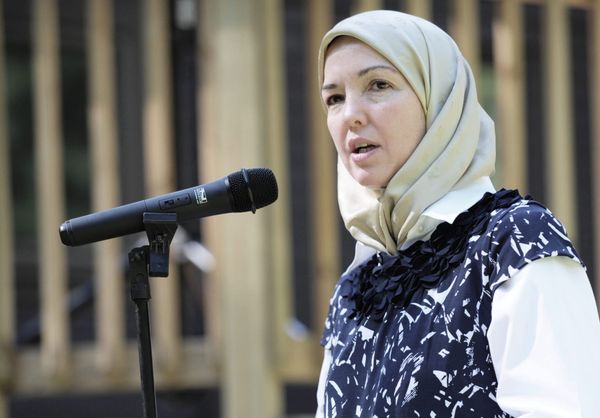
Dr. Ingrid Mattson
ISNA President Dr. Ingrid Mattson shared with the media the purpose of this year’s theme.
“The Muslim community is often reactive to negative press or events, but this year’s convention, nurturing compassionate communities, is a proactive measure to assist local communities to develop the networks and framework necessary to positively engage community members and avoid negative marginalization of Muslim community members,” she said.
Following the press conference, thousands of Muslims joined together in Jummah Prayer, led by ISNA Vice President, Imam Mohamed Magid.
Friday night closed with the Inaugural Session, led by Dr. Ingrid Mattson, Safaa Zarzour and Imam Mohamed Magid.
The convention ran through Monday July 5
A diverse array of speakers addressed this year’s convention, with topics ranging from green energy, media literacy, the Prophet Muhammad, Quranic studies, Muslim American identify formation, family and education to nurturing a halal way of life.
Thousands of attendees packed the main hall for Saturday evening’s main session.
Entitled “Nurturing Compassionate Communities: Connecting Faith and Service,” the session addressed this year’s theme by highlighting ways North American Muslims can reach out and serve the community at large.

Imam Suhaib Webb
The list of dynamic speakers included well-known favorites Hamza Yusuf and Suhaib Webb as well as much anticipated keynote speakers, Professor Tariq Ramadan and Grand Mufti Shaikh Ali Gomaa of Egypt.

Professor Tariq Ramadan
“Working for unity does not mean working for conformity,” Tariq Ramadan told the large audience.
“Remember that compassion towards one’s self is also important. If you come with sincerity, Allah will come with love.”

Shaikh Hamza Yusuf
Shaikh Hamza Yusuf emphasized the importance of proper understanding in religion while urging the promotion of accurate and accredited scholarship.
“Religion is more powerful than any temporal government,” he said. “Religion is powerful, but it is also dangerous. Our religion is a beautiful religion and it is being made ugly by the acts of fools.”
Nearly ten thousand people attended the main session.

Rashad Hussain
America’s Special Envoy to the Organization for Islamic Conference (OIC) Rashad Hussain read a letter from President Obama highlighting the positive engagement of the Muslim community and ISNA in his United We Serve Campaign.

Shaikh Ali Gomaa
The session closed with remarks from the Grand Mufti of Egypt, Shaikh Ali Gomaa. Who shared his vision of community and compassion.
Imam Siraj Wahhaj Honored at This Year’s Community Service Luncheon
ISNA’s 11th annual Community Service Recognition Luncheon was held on Saturday afternoon during the convention.
This year, ISNA honored Imam Siraj Wahhaj with the 2010 Community Service Recognition Award.

Imam Siraj Wahhaj
“I am honored. As a result of this token you have given me, I am even more committed to serve,” said Imam Siraj Wahhaj.
Wahhaj is the current Imam of Masjid Al-Taqwa in Brooklyn, New York and Chair of the Muslim Alliance in North America (MANA).
In addition, he has many years of service to ISNA as a former Vice-President and as a member of the Majlis Ash-Shura and ISNA Planning Committee.
Ahmed ElHattab, Executive Director of the ISNA Development Foundation, said, “Imam Siraj has a long history of dedicated service to his community. He has worked tirelessly to rid the streets of Brooklyn from crime, drug abuse, and violence, with awards and recognition from the Brooklyn Police Department, among others.”
600 people attended the event which included a fundraising portion.
Over 400,000 dollars in donations were pledged to support ISNA programs and services to Muslim communities nationwide.

Safa Zarzour
Safaa Zarzour, ISNA Secretary General, reassured the audience of ISNA’s commitment towards serving and uniting Muslim Americans.
“One of the most pressing issues we are facing now is our ability to connect with our affiliates and grassroots organizations. ISNA promises to create programs that connect Muslims with one another across the Unites States. Your help today is going to be used wisely to help get ISNA where it needs to be in our communities.”
Keynote speaker, Professor Tariq Ramadan, emphasized the importance of Muslim involvement in broader social issues and not just self interests.
“We must ask ourselves, who do we serve; power or justice; money or truth. As Muslims we have to serve all the people around the world.”
ISNA Celebrates Work of Muslim, Interfaith and Government Leaders to Nurture Compassionate Communities
The 47th Annual ISNA Convention was packed with members of the interfaith community and government officials, as both speakers and attendees.
On Friday July 2, ISNA President Dr. Ingrid Mattson welcomed more than 70 national Muslim and interfaith partners to the Presidential Reception for Dignitaries.
Dr. Mattson thanked all in attendance for graciously accepting her invitation to participate in the reception, which provided an opportunity for the leaders to network, enjoy themselves, and strengthen bonds of community leadership.
The morning of Saturday July 3 began for many leaders with the Government Officials Breakfast, chaired by Dr. Ingrid Mattson and Imam Mohamed Magid.
This event was attended by ISNA leadership, along with more than 50 national Muslim leaders, representing many of the diverse American Muslim organizations from across the nation and U.S. government officials.
Representatives from the federal government included Mr. Rashad Hussain from the White House, Mr. Mazen Basrawi from the Department of Justice, Mr. George Selim from the Department of Homeland Security, and representatives from USAID.
The Muslim leaders raised issues facing the American Muslim community, including terrorist watch lists, travel problems, visa issues, and religious accommodation in the military.
Government officials in attendance responded to most of these issues and promised their cooperation to find resolution to other issues raised in the meeting.

Shaikh Ali Gomaa, Imam Magid Ali, and Professor Tariq Ramadan
Dr. Ingrid Mattson also chaired a luncheon in the afternoon of Sunday July 4 to honor Shaykh Ali Gomaa and Professor Tariq Ramadan.
The event was attended by more than 60 Muslim scholars and leaders of various Islamic organizations and provided an opportunity for all to learn from Shaykh Ali Gomaa who spoke to attendees about the misunderstandings of Islam and its effect on the image of Islam.
“In its correct understanding, Islam focuses on ethics, morality and cooperation,” he said.
Shaykh Ali also condemned violence in the name of Islam and urged the promotion of peace and compassion within our communities.
[Report compiled with files from ISNA]
Tariq Ramadan on rediscovering the Muslim Identity
by Hasan Zillur Rahim
[Islamic Circle of North America (ICNA) recently held a fundraiser in Northern California for its various Islam Awareness programs, including billboards in major cities in the U.S. on “Why Islam?” ( http://www.whyislam.org ) and providing halal food to the homeless in mobile soup kitchens – Mercy on Wheels – in the San Francisco Bay Area, to expand to other parts of the country in future. Professor Tariq Ramadan, the noted Muslim theologian and writer, was the keynote speaker. He spoke on the theme of “Islam Indeed: Rediscovering the Muslim Identity.” This is a summary of his talk.]
Do not let others define who you are. If our idea of moderation springs from a defensive mentality, we end up appeasing others. If we are too aggressive, it implies that we are reacting to what others are saying about us.
The ideal state is to engage with others at the center, not at the periphery, in a peaceful and spiritual way. It is easy to remain in our own cocoons. Far more difficult is to participate in the affairs of society. How we say what we say to Americans is important. We can be who we are and what we want to be without isolating ourselves from the urgent issues of society. Right terminology is important. Orientalists would like to define Muslims by their invented terms. We cannot allow this to continue. We are on an equal footing with them and must be intellectually assertive to define our own terminology.
The way we behave has a profound impact on how others view us. It is easy to preach peacefulness but if our behavior in society suggests otherwise, we lose. We must remember that communication is a two-way street. It is not: “I speak, you listen.” We have to learn from our surrounding society. To do that, we must know its culture, context, history. We must cultivate the art of listening and learn to be humble. Listen to the indigenous people, to African-Americans and Latinos who may be new to Islam but who have been Americans far longer. Don’t patronize them. They have much to teach us. We are often obsessed with Palestine and international issues while ignoring the pressing concerns of society right here. Balance is the key.
Arrogance in faith is one of our vices. We have no right to decide or declare who is or is not a Muslim. That is for Allah (SWT) alone to decide. A non-practicing Muslim today may become a better Muslim than you and me tomorrow by Allah’s grace. It is not for us to be the judge of someone’s religiosity.
Life is a test of our faith. There can be no faith without Jihad an Nafs, the constant struggle to purify our soul. Islam is incomplete without education. There is widespread illiteracy about Islam and Muslims. It is our obligation to transmit the essence of our faith to our children and to society. More important is to act on our faith. We must be the best example of our faith through our behavior.
We must keep the good of the society foremost in our minds. There is no returning to the old country. America is home to you. We have to overcome any psychological barrier to integrating with the society. At the same time, we must convince Americans to integrate us into their minds as well. This requires nurturing the media. It also requires patience and perseverance. We have to care about things that do not involve Islam and Muslims.
We must not shy away from speaking about spirituality, particularly in a consumerist society. American Muslims are better able to practice Islam than in many so-called Islamic countries. To give only one example: There are six Muslim countries where I am barred from traveling.
The entertainment industry is a powerful force in America. For American Muslims, it is an opportunity to make entertainment a force for common good in society, instead of what it is today.
In the United States, fatherhood is a huge problem, for Muslims as well as for people of other faiths. Many fathers are absent from the lives of their children. In pursuing career, wealth, fame or simply giving in to unworthy impulses, fathers are squandering opportunities to bring up their children in the right way. Muslim fathers must live up to their responsibilities in raising their children.
While we must be sincere in becoming a light for the society, we must not be naïve. We have to learn how to deal with and speak to power. The Prophet (saw) dealt with power all his life. We must be loyal to the country that is our home, but it must be a critical loyalty in that we have to support what is right and oppose what is wrong. If any Muslim says, I am not going to engage in politics, he or she must know that “no politics” is also politics.
Our goal is to best serve our society. Human dignity is the same for all. To be self-critical is to be humble. We should not be formalistic, forever debating, for instance, what is halal and what is haram. Our spiritual identity is shaped by our love of Allah. To act on His command is to speak to Him. Our hearts and minds must be engaged in a deep conversation about our role in society. This is jihad.
#
Source: www.theamericanmuslim.org
Tariq Ramadan on radically reforming Islam
(April 12, 2010) -Tariq Ramadan, a world-renowned Swiss Islamic scholar, is currently making his first appearance in the U.S. since the State Department barred him from entering the U.S. in 2004. On Monday, he spoke at Georgetown University in Gaston Hall along with School of Foreign Service Professor John Esposito about the need for the radical reform in Islam.
Ramadan’s visa was revoked six years ago as he was about to travel to the U.S. to become a professor at the University of Notre Dame. The State Department cited small donations Ramadan made to a pro-Palestinian group in from 1998 to 2002 which was suspected of giving money to Hamas, a group that made the State Department terrorist list in 2003.
In Gaston, Ramadan talked about the theory driving his recent work, that Islam needs “radical reform.” Speaking animatedly and rapidly on the stage from which, six years earlier, he had spoken by satellite because of his travel ban, he said that Muslims should reject the notion that tradition is immovable and that sacred texts cannot be reinterpreted in a contemporary context.
“We need a radical reform in the way we deal with [religious] texts in the context of our time,” he said, adding that while there is an impulse for Muslims to adapt interpretation of sacred texts to the changing world, Muslims also “need to come back with a more approach in light of the text to transform the world.”
“Tradition is moving,” he said. “Show me one tradition that isn’t moving. It doesn’t exist.”
Esposito asked Ramadan to clarify his use of the word “radical.”
“It’ll make a great headline,” Esposito joked. “Tariq Ramadan advocates for radical reform of Islam at Georgetown University. And then we’re in trouble.”
Laughing, Ramadan said he was seeking an “intellectual revolution.”
“This is radical in that I am challenging … the type of authority tradition has in all fields,” he said. “You will see that even sharia is built through human interpretation. We are speaking about immutable principles, but those [only] help you construct the framework, you still construct it.”
In his remarks, Esposito compared Islamic reformers like Ramadan to the Catholic vanguard whose views, which were once viewed negatively, became mainstream belief and practice after Vatican II.
“[The question is] do you realize sacred texts like the Quran are meant to be interpreted over and over again, or do you buy into the idea that interpretations that were made in the past at a classical period are fixed?”
During the question and answer period, Ramadan answered audience questions about the problem of reforming Islam in autocratic countries and about mistreatment of religious minorities in Muslim-majority countries.
“I really respect what you’re trying to do, but I think that you have an obligation to minorities in Muslim-majority countries who are discriminated against,” one audience member said, adding that he does not “hear enough voices” speaking out against discrimination.
Ramadan responded with a comment that criticized Western media.
“I cannot say that enough is done and said. But you have to listen, because there are Muslim scholars who are speaking out against discrimination all the time. In this country, the story goes, and you say, ‘You don’t say enough.’ Well, I say it every day.”
The Q & A session peaked when a man who identified himself as a reporter asked Ramdan about his theory with open condescension.
“You’ve talked about radical reform. Well, here in the West, we press for examples. So I’m gonna press you for an example,” he said. He asked how Ramadan would apply his theory of transformed religion to the problem of the forced marriage of very young girls in some Muslim-majority countries.
“How would your radical reform work? How do you apple your logic to any problem if it’s not this problem? We in the West like our examples up front,” he continued.
The moderator interrupted to tell the man that reporters could ask questions at a separate press conference after the event, but Ramadan responded anyway.
“What I’m talking about, as you’re suggesting, it should have application. What I’m trying to say here is, think about the context … I would push, first, for a very clear principle. Forced marriage—it’s un-Islamic. Unethical. That’s without question. How do you say that in light of the context? In light of the context, we push for a woman’s right to marry when she has the agency to decide to.”
His answer was met with applause, and it was not the only statement he made that was as well received. When an audience member said he had seen dueling forms of religious destruction—minaret bans in Switzerland, French bans on the hijab, and the destruction of Christian churches in the Middle East, Ramadan gave another response that drew applause.
“I don’t need context here. Just the principles. Anything that has to do with the churches or the symbols of other religions, they should be respected. End of discussion,” he said. To do otherwise, he continued, and to ban other viewpoints, is “acting against the very spirit of the Swiss Constitution, the French Constitution, and the American Constitution, just because we are scared.”
Source: Posted by Molly Redden on Vox Populi, the staff blog of the Georgetown Voice, a weekly newsmagazine at Georgetown University. Opinions expressed in posts are those of their author alone unless otherwise stated.
Tariq Ramadan to Make First US Appearance Since Lifting of Ban
(March 18, 2010) – PEN, the ACLU, the American Association of University Professors (AAUP), and Slate will join forces to present Tariq Ramadan’s first public appearance in the United States since he was barred from entering the country in 2004.
PEN, the ACLU, and the AAUP won a Supreme Court case against this instance of intellectual exclusionism to allow Ramadan—one of Europe’s most respected Islamic scholars and chair of Oxford University’s Islamic Department—back into the U.S.
The April 8 event will offer a unique opportunity to hear Professor Ramadan talk about issues relating to secularism, Islam, and democracy, along with author Ian Buruma, and author/Obama advisor Dalia Mogahed.
“Switzerland votes to prohibit the construction of minarets”; “France debates barring women from wearing the niqab and burqa”; “The United States seizes the assets of the largest American Muslim charities”—such headlines suggest an increasingly polarized relationship between Islam and liberal, secular democracies, especially in Europe.
Is this the full story? Is there a fundamental clash of values between secularism and Islam and between freedom of expression and freedom of religion? In what ways are Muslims living in the West contributing to democratic societies? Can Islam exist as a Western religion? Is it a Western religion already? How do we better understand the life of the Muslim community within various Western societies?
The panel which will address these questions at the Cooper Union’s Great Hall also include the journalist Ian Buruma; Dalia Mogahed, director of the Gallup Center for Muslim Studies; and Joan Wallach Scott, a professor of social science at the Institute for Advanced Study and the author of “The Politics of the Veil.”
The panel will be moderated by Jacob Weisberg of Slate.
The author of more than 20 books, including Western Muslims and the Future of Islam, Islam, the West, and the Challenges of Modernity, and To Be a European Muslim, Tariq Ramadan was Professor of Islamic Studies and Luce Professor of Religion Conflict and Peacebuilding (Kroc Institute) at the University of Notre Dame.
In 2004, the Bush administration revoked his visa just days before he was scheduled to begin teaching. PEN, the American Academy of Religion, and the AAUP joined a lawsuit brought by the ACLU to challenge Professor Ramadan’s exclusion, and late last year an appeals court in New York ruled that the government had failed to provide a sufficient legal basis for its action. In the wake of that ruling, in January 2010, Secretary of State Hillary Clinton issued an order that effectively ended Professor Ramadan’s exclusion.
This event is presented as part of an initiative to promote national reflection and accountability in the United States.
It also celebrates a victory of important principle—that American audiences should be able to hear directly from important figures such as Professor Ramadan.
#
EVENT INFO: Secularism, Islam, and Democracy: Muslims in Europe and the West
When: Thursday April 8, 2010
Where: The Great Hall at Cooper Union, 7 East 7th Street, New York City
What time: 7:30 p.m.
With Ian Buruma, Dalia Mogahed, Tariq Ramadan, Joan Wallach Scott, and Jacob Weisberg
Tickets: $15/$10 for PEN/ACLU Members and students with valid ID. Tickets available through www.smarttix.com or (212) 868-4444. They may also be purchased at the door. Seating is by general admission, on a first-come, first-served basis.
Co-sponsored by Cooper Union, AAUP, ACLU, and Slate
Tariq Ramadan to deliver lecture on Faith in Public Life at McMaster University
(March 8, 2010) – Faith in Public Life will be the topic of the Cordoba Dialogues lecture that will be delivered by Professor Tariq Ramadan at McMaster University on Tuesday, March 16.
Tariq Ramadan is Professor of Contemporary Islamic Studies at Oxford University and a Senior Research Fellow at Doshisha University, Kyoto, Japan.
He is currently President of the think tank, European Muslim Network in Brussels.
Named by TIME magazine as one of the 100 most important innovators of the 21st century, Tariq Ramadan occupies a unique place among leading Islamic thinkers.
He was recently listed by the Foreign Policy Magazine among the top 100 global thinkers who shaped our world in 2009.
The lecture is sponsored by McMaster University (President’s Office, Department of Religious Studies and McMaster Libraries) and Cordoba House.
The Hamilton based, Cordoba House’s mission is to foster dialogue, facilitate understanding, and promote research on Islam and Muslims in Canada and the role of faith in public life.
Lecture: Faith in Public Life
Location: McMaster University, Kenneth Taylor Hall, B116
Time: 7:30 p.m.
http://cordobahouse.ca/
Islam’s role in an ethical society
By Tariq Ramadan
Let us agree on this: we live in pluralistic societies and pluralism is an unavoidable fact. We are equal citizens, but with different cultural and religious backgrounds. So, how can we, instead of being obsessed with potential “conflicts of identity” within communities, change that viewpoint to define and promote a common ethical framework, nurtured by the richness of diverse religious and cultural backgrounds? After all, a pluralistic society needs a strong and effective ethics of citizenship in order to face up to both its internal challenges (diversity, equal rights, racism, corruption, etc) and international challenges (economic crisis, global warming, migrations, etc).
Here’s one principle for reaching that goal: an ethics of citizenship should itself reflect the diversity of the citizenship. For while we agree that no one has the right to impose their beliefs on another, we also understand that our common life should be defined in such a way that it includes the contributions of all the religious and philosophical traditions within it. Further, the way to bring about such inclusion is through critical debate.
When it comes to the new Muslim presence in western countries, that critical debate is hard to achieve. Islam is perceived as a “problem”, never as a gift in our quest for a rich and stimulating diversity. And that’s a mistake. Islam has much to offer – not least when considering how individuals in politics and business have recently been behaving, within the limits of the law, but with a clear lack of ethics.
Islamic literature is full of injunctions about the centrality of an education based on ethics and proper ends. Individual responsibility, when it comes to communicating, learning and teaching is central to the Islamic message. Muslims are expected to be “witnesses to their message before people”, which means speaking in a decent way, preventing cheating and corruption, and respecting the environment. Integrity in politics and the rejection of usurious speculation in economics are principles that are pushing Muslim citizens and scholars to explore new avenues that bring public life and interpersonal ethics together.
More broadly, the Muslim presence should be perceived as positive, too. It is not undermining the Greco-Roman and Judeo-Christian ethical and cultural roots of Europe. Neither is it introducing dogmatism into the debate, as if spiritual and religious traditions automatically draw on authoritarian sources. They can operate within both the limits of the law and in the open public sphere. On the contrary, the Muslim presence can play a critical role in thinking about our future and shaping a new common narrative. It can help recall and revive some of the fundamental principles upon which the cultures of Europe are based.
To put it another way, Muslims remind their fellow citizens that one cannot simply get rid of older ethical traditions and replace them with a supposedly neutral rule of law or by impartial values formed in a free market. To agree on the rule of law, equality and democratic transparency is surely not enough. Contemporary crises within societies, and at the international level, remind us we need more ethics in our public life, not merely more efficiency.
Whether we can agree on the content of a common ethic is another question entirely. But this is where critical and indepth debates should take place, and it’s in this way that the issue of our plural future together should be determined. That future cannot be shaped by superficial discussions of national identity, values or Britishness. Similarly, we must stop treating diversity as a hindrance, for it should be exactly the opposite. Rather, an ethics based on our common citizenship must be forged from a serious and profound engagement with the meaning of our common humanity.
A Catholic perspective on the theology of Tariq Ramadan
By Hind Al-Abadleh
On Friday, February 12, 2010, Professor Gregory Baum from the Centre Justice et Foi and McGill University delivered a public lecture at the Waterloo Lutheran Seminary at Wilfrid Laurier University in Waterloo, ON.
The title of his talk was Islam and Democracy: A Catholic Perspective on Reform and Renewal, which is based on his cr itical analysis of the scholarly work of Professor Tariq Ramadan.
Professor Baum based his lecture on his latest book, The Theology of Tariq Ramadan: A Catholic Perspective.
The Reverend Dr. David Pfrimmer welcomed the attendees to the lecture and invited Dr. Scott Kline from St. Jerome’s University (a public Catholic university affiliated with
the University of Waterloo) to introduce the speaker.
Professor Baum started his talk by saying that his interest in Ramadan’s work started when he recognized the high unemployment rate among Muslims in Montreal compared to other faith groups.
He was troubled by this finding and was “deeply hurt” by the discrimination and prejudice that Muslims face.
He said that the news, press and TV coverage against Muslims have negative effect on their economic status.
Stemming from his sense of “solidarity with Muslims”, Professor Baum associated himself with Presence Musulmane in Montreal, which is a group of Muslim citizens who follow the ideas of Tariq Ramadan.
Professor Baum took on the task of reading Ramadan’s books and articles, watch his TV interviews, and listen to his lectures when Ramadan visited Montreal.
He also read the published work of Ramadan’s critics.
Professor Baum concluded that those who criticize Ramadan have not read his scholarly works.
Critics misquote Ramadan often by taking his ideas out of context.
Hence, Baum devoted his latest book as a defense of Ramadan.
Professor Baum said that religion in general is challenged by modernity that emphasizes concepts such as human rights, democracy, freedom of religion, and freedom of press.
He said that Catholics in the 19th century rejected these ideas and demanded of believers to be faithful to the king or prince.
Such encounters forced Catholic thinkers to re-read their Scriptures in light of the reality the believers are faced with.
He said that Muslims struggle now-a-days is similar to what Catholics went through.
This struggle started by the end of the 19th century, when Jamal Al-Afghani was openly critical of the Ottoman empire’s policies and called for reform.
Professor Baum said that Professor Ramadan locates himself within this reform movement.
Ramadan identifies himself as a Western Muslim who concerns himself with how to be a faithful and responsible citizen at the same time.
Ramadan does that by emphasizing the universal message of the Quran, which confirms and corrects previous revelations throughout human history.
Ramadan emphasizes that revelation and reason are in harmony.
Ramadan defines “fitra” in the Quran as the orientation of humans towards the Divine, which originates from the “breath of God” that completed the creation of humans.
This “breath of God” remains in people and with people, and using their intelligence, they will be able to recognize good and evil.
Professor Baum said that when he reads Ramadan’s definition of fitra, he is reminded of early Christian theology that the Grace of God is in all humanity.
Professor Baum then moved to the topic of how Ramadan is encouraging Muslim to use the universal message of Quran to interpret Sharia, by using certain interpretive principles:
1) taking into account the context in which verses were revealed
2) taking into account present context when interpreting passages of the Quran
3) respecting the laws of the land and contracts that Muslims make when they go through the process of visiting or immigrating to western countries.
Professor Ramadan also calls on Western Muslims to cease thinking of themselves as minorities by emphasizing that they can remain faithful to their traditions and also integrate in the wider society.
This is similar to Jewish communities who are perfectly integrated and also able to preserve their religious identity and traditions.
Professor Baum also noticed that arguments made by Islamic extremists are similar to those by Catholic extremists.
It is based on literal readings of the scriptures and interpretations that help their political agendas.
When it comes to religious pluralism, Professor Baum noted that the Quran is more in favor of religious pluralism than Christian scriptures.
He invited Christians to reread their books and look deeply for verses that promote religious pluralism.
Professor Baum also noted Ramadan’s analysis of the status of women in Muslim communities.
He noted that Ramadan defends the freedom of choice for women when it comes to the issue of the veil.
It should not be the State or the Community who impose the veil on women.
Professor Baum clearly said that he supports Ramadan in his defense of women’s choices.
He noted that the issue of imposing the veil is similar in Catholicism, where the Sisters dress code in Churches has to be approved by a “bunch of guys”.
Professor Baum concluded the lecture by saying that Ramadan is an academic and a “pastor”, who concerns himself with ordinary Muslim people (especially Western Muslims), and wants to help them recognize and understand their religion.
During the Q&A session, Prof. Baum was asked of his view on inter-religious dialogue.
He said that he supports them when their objective is to find common ground, and not to decide who’s right and who’s wrong.
He added that these dialogues are important when effort is made to understand the other and discover their views and insights.
He said that we should approach interfaith dialogue as a “exercise of love” in the sense that we make the effort to put ourselves in the shoes of the other to know them better.
Such interaction imposes on those involved to look at one’s own tradition with a different eye and encourages one to re-read it and re-posses it.
Professor Baum ended by saying that the question on his mind now is can there be a dialogue between believers and non-believers?
He believes that yes, it could happen, especially when (1) it occurs between those who respect religion for its positive influence on people, (2) the objective is not on who’s right or wrong, and (3) it is on issues related to the ones that touch us all that include ecology, peace, and justice.
Professor Baum sees this dialogue needed for establishing the “ethical foundation of modern society”.
The organizers thanked the speaker and presented him with a gift.
Professor Baum was available after the talk to briefly meet those who attended and wanted to thank him in person. He signed my copy of his latest book.
Overall, Professor Baum was a gracious and inspirational speaker whose positive energy was felt by all who attended.
He emphasized “religious solidarity” many times in his talk. I feel lucky to have met him in person and heard directly from him his analysis of Ramadan’s work.
Professor Baum’s lecture was taped and it will be uploaded on the Seminary’s website for people to download.
The link is: http://www.seminary.wlu.ca/wednesdaylecture.php
The Quest for Meaning
How different are the various religions and traditions of thought?
How can we see past our differences and discover what we have in common?
In his upcoming book scheduled to be released later this year, Tariq Ramadan, philosopher and Islamic scholar, invites the reader to join him on a journey to the deep ocean of religious, secular, and indigenous spiritual traditions.
Ramadan interrogates the concepts that frame current debates including: faith and reason, emotions and spirituality, tradition and modernity, freedom, equality, universality, and civilization.
He acknowledges the greatest flashpoints and attempts to bridge divergent paths to a common ground between these religious and intellectual traditions.
He calls urgently for a deep and meaningful dialogue that leads us to go beyond tolerant co-existence to mutual respect and enrichment.
This is an important, timely and intelligent book that aims to direct and shape debate around the most important questions of our time.
Product Details:
Paperback: 256 pages
Publisher: Penguin Ireland (Sep 21 2010)
ISBN-10: 1846141516
ISBN-13: 978-1846141515
US Government Lifts Ban on Tariq Ramadan
(January 20, 2010) – In a major victory for civil liberties, Secretary of State Hillary Clinton has signed orders that effectively end the exclusion of two prominent scholars, Professors Tariq Ramadan and Adam Habib, who were barred from the United States by the Bush administration.
“The orders ending the exclusion of Adam Habib and Tariq Ramadan are long overdue and tremendously important,” said Jameel Jaffer, Director of the American Civil Liberties Union (ACLU) National Security Project. “For several years, the United States government was more interested in stigmatizing and silencing its foreign critics than in engaging them.
The decision to end the exclusion of Professors Habib and Ramadan is a welcome sign that the Obama administration is committed to facilitating, rather than obstructing, the exchange of ideas across international borders.”
During the Bush administration, the U.S. government denied visas to dozens of foreign artists, scholars and writers – all critics of U.S. policy overseas and many of whom are Muslim – without explanation or on vague national security grounds.
In a speech in Cairo in June 2009, President Obama addressed the relationship between the United States and Muslims around the world, calling for “a sustained effort to listen to each other; to learn from each other; to respect one another; and to seek common ground.” The ACLU welcomed the State Department’s orders as an important step toward achieving that goal.
“Given the orders issued by Secretary Clinton, we hope and expect that Professor Habib and Professor Ramadan will soon be able to come to the United States to meet and talk with American audiences,” said Melissa Goodman, staff attorney with the ACLU National Security Project. “The Obama administration should now conduct a broader review of visas denied under the Bush administration, reverse the exclusions of others who were barred because of their political beliefs and retire the practice of ideological exclusion for good.”
The orders signed by Secretary Clinton state that, in the future, Professors Habib and Ramadan will not be denied visas on the same grounds that they were denied them in 2006 and 2007.
To enter the United States, however, the scholars will need to apply for visas – a process likely to take several weeks.
The ACLU expects that, given Secretary Clinton’s orders, the visa applications will be granted expeditiously.
Professor Tariq Ramadan is Chair of Contemporary Islamic Studies at St. Antony’s College, Oxford University.
In 2004, he accepted a tenured position at the University of Notre Dame, but the U.S. government revoked his visa just days before he was to begin teaching there.
“I am very pleased with the decision to end my exclusion from the United States after almost six years,” said Ramadan. “I want to thank all the institutions and individuals who have supported me and worked to end unconstitutional ideological exclusion over the years. I am very happy and hopeful that I will be able to visit the United States very soon and to once again engage in an open, critical and constructive dialogue with American scholars and intellectuals.”
Professor Adam Habib is a respected political analyst and Deputy Vice Chancellor of Research, Innovation and Advancement at the University of Johannesburg, as well as a Muslim who has been a vocal critic of the war in Iraq and some U.S. terrorism-related policies.
“My family and I are thrilled by Secretary Clinton’s decision, and we are thankful to the many organizations that put pressure on the Obama administration to stop excluding people from the United States on the basis of their political views,” said Habib. “This is not only a personal victory but also a victory for democracy around the world, and we hope this signals a move by the administration to begin restoring the liberties and freedoms that have been so badly eroded in recent times.”
Solitude between ourselves and our self
By Tariq Ramadan
(December 15, 2009) – Someday we are bound to come back to the beginning. Even the most distant pathways always lead us inwards, completely inwards, into intimacy, solitude between ourselves and our self – in the place where there is no longer anyone but God, and our self.
Paulo Coelho, in his novel The Alchemist, has brought in one of the most traditional and deep teachings of Sufism (Islamic mysticism). Go, travel the world, watch, look for the truth and the secret of life – every road will lead you to this sense of initiation: the light, the secret, are hidden in the place from which you set out.
You are on your way not towards the end of the road, but towards its beginning; to go is to return; to find is to rediscover.
Go!…You will return.
The apparent paradox of spiritual experience is the lesson that the constant effort, the jihād, that we make in order to purify, control and liberate our heart is, in the end, a reconciliation with the deepest level of our being (al-fitra) – there where the spark that God originally breathed into our heart gleams, there where our conscience weds our being and gives in to peace (salām).
The peace of recognition, the peace of submission (salām al-islām), is, deep down, a liberation.
God is “The One who created death and life to test you and to find out which of you would behave best.”
Death, life, experiences, ordeals, pain, solitude, as well as joy and happiness, are so many lessons along the road to reconciliation. Wounds, separations, tears, as well as smiles, “say” something: if you live in unawareness, they touch you; with God, they guide and lead you.
Where to? Where to then? Towards Him, towards you, close to Him in you.
Such is the most beautiful and the most difficult lesson of Islam: you find God only by rediscovering your own nature and the essence of your nature is the only thing that can free you from its appearance… “I” must set out to discover another “I”: such is the meaning of life.
Ordeals do not drive you to your limits, but to your origin, where “the need for Him” has its root. Ordeals will lead you back, whether you like it or not, to what you are, to the essence from which He has formed you. Exile will take you home.
A man once exclaimed to the mystic Rabia al-Adawiyya, “I have discovered a thousand proofs of the existence of God!” She closed the conversation by saying that she had only one proof and that was enough for her. “Which?” he asked. “If you are alone in the desert and you fall down a well, to whom will you turn?” “To God,” he said. “That proof is enough for me!”
A strange reply, seemingly simple, even simplistic, that a rationalist or atheist would without hesitation take as confirmation of what he had always believed: “God is the refuge of the destitute, the hope of the hopeless, a consolation, a reassuring invention!”
On the surface, but only on the surface… suffering and the unknown seem to press the mind to look for a refuge, a consolation. This is the logic our reason proposes when it looks on the human being on the outside of its nature.
The Islamic tradition says exactly the opposite: the ordeals of life, sadness, encountering the death of those we love, for example, take the human being back to its most natural state, to its most essential longing. Consciousness of limitation brings it back to the need for the Transcendent, to the need for meaning. To call on God is not to console oneself – it is to rediscover the condition God originally wanted for us – the spark of humility, the awareness of fragility.
Before your eyes is a child … life, dependence, fragility and innocence.
To be with God is to know how to keep this state: a humble acceptance of your fragility, a comprehension of your dependence – going back to the beginning. In fact, the temptation of pride consists in thinking that man can cut himself off from his nature and attain total intellectual autonomy to the point where he can take on his own suffering, deliberately and alone.
Pride is to affirm outward independence by maintaining the illusion of liberty at the heart of one’s being. Humility is to rediscover the breath of the primordial need of Him at the heart of our being, in order to live in total outward independence.