Danforth Islamic Centre sets example in fight against malaria
(April 21, 2010) – The Danforth Islamic Centre (DIC) located in Toronto’s east end joined in the Congregations Act to support the Fight Against Malaria campaign and has set an example for other faith communities by tripling its fund-raising target.
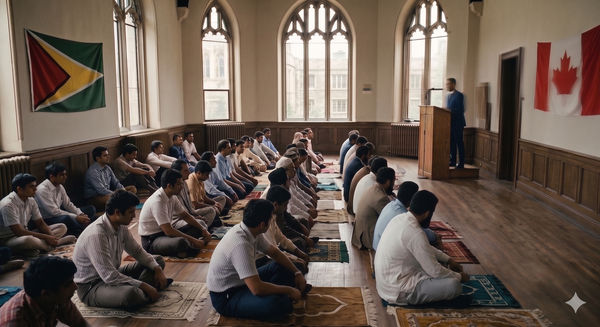
On Friday April 9, 2010 an awareness building and fund raising drive to fight malaria was organized after the regular Friday prayers at the Centre and over $300 was raised.
Although raising the target of $100 looked doubtful in this congregation, which is situated in one of the priority neighbourhoods in Toronto, the faithful contributed $315 for this cause.
“Specifically we are asking congregations across Canada to include an educational announcement in worship bulletins during Faiths Act week, April 25th to May 1st and consider raising $100 for 10 life saving bed nets,” Erica Spracklin, a Faiths Act Fellow and organizer of the Fight Against Malaria campaign, told Iqra.ca.
Crescent Town is one of the priority neighbourhoods where over 40% of the 16,000 population lives under the poverty line and 39.6% of the population are newcomers to Canada.
The newcomer percentage is higher in this dense neighbourhood compared to the Toronto average of 21.6%.
There are three mosques in the area serving a predominantly Bangladeshi community.
It is quite understandable that Danforth Islamic Centre didn’t expect to raise the bare minimum of $100 from those who attend the Friday service.
So, as a generous gesture towards this cause, the Dandforth Islamic Centre management committee agreed to top up whatever was raised to make up the $100 minimum amount.
However, the congregation stepped up and donated over $300.
The Friday sermon was delivered by Sheikh Irshad Osman (Naleemi), who spoke about the effect of malaria which kills over 1 million people every year, most of them children under 5 years old.
In his latest series of monthly Friday lectures, Osman has been speaking to the congregation about assisting people of other faiths and not constraining themselves to their own communities.
“Religion is not local; it is not ethnic; it is not selfish. Rather it is a global force for good, encouraging its followers to assist one another and look after the welfare of one another, irrespective of others’ religion, creed, or skin colour,” Osman said.
“Show compassion to those on earth; you will be shown compassion by those in the heavens,” he quoted one of Prophet Muhammad’s famous sayings.
The congregation was informed that every 30 second 1 child breathes its last because of malaria, an entirely preventable and treatable disease.
Irshad Osman encouraged the gathering to make a difference in the lives of fellow human beings.
“This is an excellent opportunity to show your compassion to people of Africa. The funds you raise today will be invested to buy bed nets for vulnerable families. They all are creation of Almighty God. Our roots are same. Our values are same. We should feel other’s pain. Losing one member in our family is not easy. How about when it happens annually to some communities? Let’s get together to help. This kind act will be rewarded immensely in this world and the hereafter”
#
Congregations from diverse faiths across Canada have come together in solidarity to support a national initiative, from the Maritimes to the prairies including Montreal, Toronto and Ottawa. To see a complete list of all congregations please visit www.congregationsact.com.
Haiti Earthquake – was it punishment from God?
By Irshad Osman
Another disaster….this time in the Western hemisphere.
We all stood bewildered and dumbfounded upon hearing the news of the earthquake in Haiti.
The number of deaths in Haiti is estimated at over 300,000 while the displaced are over 1 million.
Another 1.5 million people have been afflicted, one way or another, by this calamity – that puts the total number of Haitians affected at approximately 3 million people, which is one third of the population!
This is the scale of the blow to a nation which is the poorest in the Western hemisphere.
In the wake of this disaster, many Muslim organizations from North America stepped forward to offer humanitarian assistance to the victims.
Some are still working in the field, serving their brethren in humanity and performing their religious obligations.
While the humanitarian efforts are intensified on many fronts to assist the helpless, some people think that this calamity is a punishment from God for a nation that practices Voodoo and, thereby, transgresses against the Almighty Lord!!!
Ironically, this paradigm resembles the question posed by some agnostics to people of faith – “Why does your God punish the innocent people in such a cruel way?”
The objective behind such a question is to portray the Almighty, who they do not believe in, as cruel and sadistic and, regrettably, some Muslims’ views in regard to natural disasters strengthen this argument.
I have two reservations in accepting the verdict of “being punished” – first, if punishment from God is the explanation for the disaster in Haiti, how do we interpret the calamities involving Muslim communities, e.g. earthquakes in Turkey and Iran, the tsunami in Indonesia, flash Floods in Bangladesh etc?
And second, if not following Islam is the criteria to unleash God’s punishment, shouldn’t the Muslims who don’t follow Islam, after accepting Allah’s sovereignty and receiving clear guidance on what is right and wrong, be chastised first instead of a community who neither received the message of Islam nor rejected it?
The proponents of the above argument quote Qur’anic verses on how previous nations were destroyed due to their rebellion against Allah.
However, they forget, that those nations were destroyed when the prophets and righteous among them exhausted all possibilities in guiding their societies.
Everyone in that community received the message from God.
But they not only rejected it, but went on creating moral and social corruption in their respective communities to the extent that living among them would have corrupted their contemporaries as well as the future generations.
This is evident in the supplication made by Prophet Noah:
Noah said, “My Lord, do not leave upon the earth from among the disbelievers an inhabitant. Indeed, if you leave them, they will mislead your servants and not beget except wicked ones and disbelievers” (Divine Qur’an 71: 26-27)
Can this be affirmed about our current context, claiming no stone is left unturned in delivering the message of Islam?
This may be justified – although not an objective statement – for some Non-Muslim communities living among a Muslim majority, given the assumption that Muslims are actively involved in conveying the divine guidance to every single soul in that land, e.g. Hindus in Bangladesh, Christians in Pakistan, Copts in Egypt etc.
However, this becomes questionable when the community in question is a non-Muslim majority with no or few Muslims around them.
Expecting that 9 million Haitians would have learned about this faith from less than 4000 Muslims among them and consciously made a choice to not reform themselves and thus invited God’s wrath is a farfetched an idea to me.
Still the question remains – why natural disasters?
Our universe is in perfect order.
There are more than 100 billion galaxies in our universe.
Each galaxy consists of over 200 billion stars.
Such a myriad of celestial bodies!
Each of these stars and planets rotates at an incredible speed and flow through each other.
Despite the velocity and complexity of this gigantic transition, no major collisions or pileups occur.
The velocities of objects in the universe are beyond the limits of human imagination.
For instance, our planet earth rotates about its axis at an average speed of 1,670 km an hour while rotating in its orbit around the sun at a velocity of 108,000 km an hour.
The solar system known to us revolves around the centre of the galaxy at 720,000 km an hour while the velocity of the Milky Way itself is 950,000 km an hour.
This continual movement is inconceivable.
Furthermore, the planet earth, together with the solar system, moves 500 million kilometers away each year from its location of the previous year.
This shows there is an incredible equilibrium within all this dynamic movement and, thus, life on earth is based on a very delicate balance.
Very slight, even millimetric variations in the orbit of heavenly bodies could result in very serious consequences.
Some could be so detrimental that life on earth would become impossible.
In such systems, in which there is both great equilibrium and tremendous velocities, gigantic accidents may happen at any time.
However, the fact that we lead our lives in an ordinary way on this planet makes us forget about the dangers existing in the universe at large.
The present order of the universe with the almost negligible number of collisions, of which we know, simply makes us think that a perfect, stable and secure environment surrounds us.
But, the truth is, the world is anything but serene and still.
We are all vulnerable to natural threats, both internal and external.
Meteor showers, asteroids are only a few of the factors likely to pose threats to the world from space.
Internally though the threats are numerous.
As for the seemingly solid earth, the planet’s interior has an inner core of molten elements. It would not be an exaggeration to call this part of the earth “a flaming core”.
There also exists an atmosphere surrounding the earth, which is a “shield” against external threats.
Yet, no part of the earth is immune against the effects of atmospheric forces like thunderstorms, storms, or hurricanes.
Natural hazards may strike at any time.
They can cause considerable loss of life and property.
Generally referred to as “natural” disasters, earthquakes, lightning, flash floods, global wildfires, acid rain, and tidal waves have different intensities and effects.
What is common to all these disasters is that in just moments they can reduce a city, with all its inhabitants, to ruin.
What is most important, no human being has the power to combat or prevent any of these hazards.
Heavy destruction is the legacy of catastrophes all over the planet.
Yet, a disaster always affects only a particular region of the earth, thanks to nature’s delicate balance which is a creation of Allah.
A significant protection exists on earth for all living things as well as for human beings.
The possibility of a devastating natural disaster always lurks in spite of this protection.
These disasters show us how insecure our habitation can sometimes be.
These also remind us of our inherent weakness in the face of celestial bodies.
The outbursts of nature are reminders to us that the earth we live in is not a permanent adobe.
Had it meant to be unceasing and ineradicable, it would have had a different structure than the present one.
The delicate structure of the universe is created to cease after a certain period of time.
The protection we have on earth is no guarantee against its total destruction.
For, whatever the disasters we see on a mini scale can occur on a larger scale causing tremendous destruction of life on earth.
This is not a doomsday theory of a certain cult or a Hollywood movie predicting the end of earth within a few years where the hero and a group of scientists devise a plan to escape while everyone on earth perish.
Researchers reveal that every two minutes, somewhere, the surface of the earth cracks.
According to statistics, the earth shakes hundreds of thousands of times a year.
Twenty of them are powerful earthquakes which convulse the land.
Yet only five of these earthquakes hit densely populated areas and reduce buildings to heaps of rubble.
In our day, only a city or a province becomes subject to damaging earthquakes.
Yet, by the will of Allah, an earthquake affecting the whole planet could happen at any time. This type of shaking of the ground could end life on earth.
The structure of the earth is quite vulnerable to quakes; a sudden movement or rupture of large masses of rock within the earth’s crust or upper mantle would make such a catastrophe inescapable.
Many scientists have admitted the vulnerability of our earth and its ultimate destruction.
They have published several theories on how life on earth would come to an end.
For an instance, Peter Ward and Donald Brownlee discuss in their book, The Life and Death of Planet Earth, how the sun will cease to exist after some billion years: “In approximately 5 billion years from now, the Sun will begin the final stage of its life, consuming the last of its hydrogen fuel supply. At that point, gravity will force the Sun to collapse, and only a small amount of hydrogen will remain in a shell wrapped around the star’s core. It will then expand into a red giant star. … With the end of its hydrogen, the Sun will have switched to fusing helium, then carbon, and finally oxygen. At that point, our Sun will lack the gravity to continue the fusion process. It will shut down, and shed its outside layers to form a planetary nebula. … Once yellow-hot with the heat of fusion, the Sun will slowly cool down over time. Eventually, its temperature will match the background temperature of the Universe and it will become a cold black dwarf – an inert chunk of matter floating in the darkness of space.”
It should be noted here, that scientists estimate the lifetime of our sun from their current level of knowledge and understanding of the behavior of other suns (i.e., larger stars) that are born and die in space all the time, and their understanding of the nature of the reactions that happen at the core of the sun visible to us. The exact timeline, however, is known only to Almighty Allah as the Qur’an asserts in several verses.
The Glorious Qur’an, on describing the events on the Day of Judgment, affirms the fate of the sun, stars, planets, oceans, sky and everything in the universe:
“When the sun becomes darkened, when the stars fall and disperse, when the mountains are moved away, ……..when the seas are set alight” (Divine Qur’an 81: 1-3 & 6)
“When the heaven is cleft asunder, when the stars are scattered, when the oceans are exploded” (Divine Qur’an 82: 1-3)
“When the sky is split asunder and becomes rose red like stained leather” (Divine Qur’an 55:37)
Explaining the above verses Sayyid Qutb writes: “The great events mentioned indicate that the present familiar state of the universe, with its perfect harmony, measured movement, controlled relations, perfected by a meticulous creator will suffer a breakdown of its system. It will have completed its role by then. Along with all creation, it will move into a new predetermined phase of life, unlike anything known to us in this world. The darkening of the sun probably means that it will cool down and its flames will dwindle and die down. The falling of the stars probably means that they will break away from the system that holds them together in its orbit (i.e., gravitational force) and will disappear in the wide space, like particles of dust running lose.”
All Islamic scholars and exegetes confess that these probabilities and explanations are based on their knowledge and experience. As to when exactly it will happen and how exactly it will happen can be captured only by Almighty Allah’s omniscience.
What is noteworthy here is the Qur’an’s choice of words. It uses the passive voice when speaking about the end of the world denoting it is a predictable process, for which the current structure of the universe is largely capable of.
This is in contrary to the active voice form which Qur’an uses to denote the creation of this world, as in the following examples:
“It is He who created the heavens and the earth in six days” (Divine Qur’an 11:7)
“It is He who has created for you all that is on earth, and has applied His design to the heavens and fashioned them into seven heavens; and he alone has full knowledge of everything” (Divine Qur’an 2:29)
But the events prior to the Day of Judgment are described using the fu’ila, and infa’ala verb stems to give the reader the idea of an inevitable, predetermined process.
Every creation on earth, from the largest celestial bodies to smallest creatures in this Universe, has a purpose for its existence and when the purpose is over it will cease to exist.
The Holy Qur’an explains this ultimate truth so beautifully in Sura Rum:
“Allah has not created the heavens and the earth and all that is between them without a purpose and a set term” (Divine Qur’an 30:8)
Like every human is born to this world carrying the death in his hand, this entire universe was created with the seed of destruction in it.
Thus, the natural disasters are the law of nature and it reminds us that what appears solid and strong will one day come to an end when the violent upheaval takes place.
In the aftermath of Asian Tsunamis, I recall a Sri Lankan Muslim poet expressed it with precise brevity:
“O Mini Akhirah!
Is this a rehearsal
you performed
in the Asian theater”
Contemplating on this poem, I wonder if Haitian earthquake is another rehearsal of that Akhirah performed in the Western hemisphere.
Natural disasters are great avenues to remind us of the delicate nature of this universe and our inherent weakness to alter its course.
The inevitable upheaval which lurks over us should establish in our hearts that the values and riches of this world are of little or no value.
Instead, our hearts and minds should establish a firm bond with the everlasting truth, i.e., the truth of Allah, the Eternal, Who never changes when everything else changes, weakens, falls off or disappears.
We should break the chains of what is familiar (and destructible) in this world in order to recognize this absolute truth which admits no restrictions of time, place, finite faculties or temporal standards.
“Everything upon it will perish. And there will remain forever the countenance of your Lord, owner of Majesty and Honor” (Divine Qur’an 55: 26-27)
How, then, we can achieve success when living in a world, which is prone to mini disasters and ultimate destruction, without receding into despair and dejection?
What are the keys to salvation?
“Give glad tidings to the steadfast, who say, when a misfortune strikes them, “To Allah we belong and to Him is our return” (Divine Qur’an 2: 155-156)
According to the Qur’an, the pristine guidance, those virtues are being patient when we face difficulties and showing compassion when others face the same.
For we all are in this together, sharing the same earth with its luxuries and adversaries, with the same resources with its fortunes and misfortunes, and in the same universe with its blessings and restrictions.
Tragedy and hard times do not discriminate.
We all are vulnerable on the face of earth.
We never really know, when, or if, we’ll need a helping hand.
So, the duty needs to be – without being judgmental about the fate of others – assisting with all our means the victims and the needy who struggle to overcome this trauma in Haiti.
Consoling their hearts, uplifting their spirits, strengthening their self-determination and restoring their blurred future are the religious needs of the hour.
These disasters may appear big, but they are not bigger than the compassion we have for fellow humans….these catastrophes may appear gigantic, but they cannot be compared to the magnanimousness and generosity we have as humans.
————————————————————————————————–
References:
Harun Yahya, The Truth of the Life in this World, (Web Edition, 1999), Page 10
Ibid., Page 42
Ibid., Page 44
See following online articles: Robert Roy Britt, Freeze, Fry or Dry: How Long Has the earth Got,
http://www.space.com/scienceastronomy/solarsystem/death_of_earth_000224.html and Fraser Cain, The End of
Everything, http://www.universetoday.com/2007/07/25/the-end-of-everything/
Peter D. Ward and Donald Brownlee, The Life and Death of Planet Earth: How the New Science of Astrobiology Charts the
Ultimate Fate of Our World, Times Books 2002
Sayyid Qutb, In the Shade of the Qur’an (English Translation of Vol 30), Millat Book Centre, Page 64
Ibid., Page 63
Toronto Celebrates Charter for Compassion
(November 20, 2009) – Toronto residents took part in the launch of the Charter for Compassion last week by holding lectures, discussions, film screenings, reflective walks and dedicating weekly sermons to the topic of compassion.
The Charter for Compassion, officially launched on November 12, is a 330-word document that was crafted by people from all walks of life, nationalities, beliefs and backgrounds with the intent to unify, inspire and bring compassion back into the heart of society.
The Charter initiative was funded out of the Ted Prize, awarded every year to three “exceptional individuals,” and includes $100,000 and the granting of “one wish.”
Karen Armstrong, winner of the 2008 TED prize, had the wish “that you would help with the creation, launch and propagation of a Charter for Compassion crafted by the three Abrahamic traditions of Judaism, Christianity and Islam and based on the fundamental principle of The Golden Rule.”
Events to commemorate the launch of the Charter took place across the globe from Australia and South Africa to Argentina and Thailand with more than 100 partner organizations.
To celebrate the launch, Muslim Presence Toronto, one of the many world-wide partner organizations, produced a large ‘Wall of Compassion’ banner which sought to remind people that they already share the core principles of compassion.
“I am very inspired by the Charter for Compassion which is centered on the Golden rule – ‘do unto others as you would have them do unto you,” says Afaun Mandol of Muslim Presence Toronto, organizer of the Wall of Compassion.
“We will be asking those who agree with the statement to pledge to integrate it into their life by signing the Wall of Compassion.”
On the day of the launch, November 12, the Tikkun Toronto group met at noon in the heart of High Park, the city’s largest park, in a labyrinth shadowed by a grove of oak trees.
The Charter for Compassion was read and the group took part in a reflective walk of the labyrinth and affirmed the Charter by signing of the Wall of Compassion.
Later that evening, Scarboro Foreign Missions, another partner organization featured a premier presentation of ‘Animating the Golden Rule,’ a new documentary film by Tina Petrova, followed by an interfaith panel discussion on compassion at the Multi-Faith Centre at the University of Toronto. Muslim Presence Toronto also took part in the gathering and invited attendees to sign the Wall of Compassion.
Around the city, the Muslim Friday sermons on November 13 were dedicated to the topic of mercy and compassion.
At the Anatolia Islamic Centre in Mississauga, Taha Ghayyur reminded the congregation in his Khutba (sermon) of the importance of compassion and mercy in the Islamic sources.
“It’s interesting to note that God uses the word Rahma, meaning compassion and mercy in Arabic, and its derivatives 326 times in the Quran,” he said.
“Allah did not limit His Mercy to those who believe in Him only and the Prophet Muhammad, peace be on him, shared his compassion with his neighbours and anyone he saw as disadvantaged, oppressed or needy in the community, regardless of his or her faith,” Ghayyur added.
He challenged the audience to engage in sharing and compassionate works.
“If God and His Prophet didn’t limit their mercy and compassion, what is holding us back from sharing our humanity?” he said. ”Borrowing a phrase from Piero Ferrucci, we should be concerned about the ‘global cooling’ of relations, in a world where genuine love, compassion, care, and warmth are quickly fading.”
In the east end of Toronto, Irshad Osman delivered the Khutba at the Danforth Islamic Centre, and invited the congregation to reflect on the Allah’s Mercy and Compassion for all of His creation.
“The earth we live in, the air we breathe, the nature we enjoy, the rain we benefit from are all signs of Allah’s Mercy,” he said. “These bounties in nature are not solely for us; but for every living being on earth.”
Osman then spoke of living the ethic of reciprocity in all aspects of daily life.
“For our family, friends and relatives let us live by the Prophetic advice, ‘Love; you will be loved; Forgive; you will be forgiven’; for people in need, ‘Help them as you would like to be helped’; and for relating to fellow human beings, he invoked the Qur’anic verse, ‘Treat them with kindness and justice.’
Delivering the Friday Khutba in the historic Hart House building of the University of Toronto, Muneeb Nasir reminded the congregation of the urgent need for a focus on compassion in an increasingly fractured world.
“While we are all connected as never before in human history – electronically, economically and politically – we are experiencing disconnectedness,” he said.
“We have a choice – we can choose to be bystanders, throw our hands up and despair or we can choose to become aggressive and isolate ourselves or we can be courageous and cultivate relationships based on compassion.”
“Compassion which requires us to put ourselves into the place of the other requires courage; cowards need not apply,” he added.
Nasir then reminded the audience of the nature of the relationships that Islam wants Muslims to develop.
“Compassion is connected to our capacity to love – love for others what we love for ourselves – as the Prophet Muhammad advised in the famous tradition,” he said. “When we give of ourselves we must give of what we most love as Allah says in the Qur’an, ‘You will not attain piety until you give of what you love’.”
AFFIRM THE CHARTER -> www.charterforcompassion.org

- Afaun Mandol, Muslim Presence Toronto, organizer of the Wall of Compassion