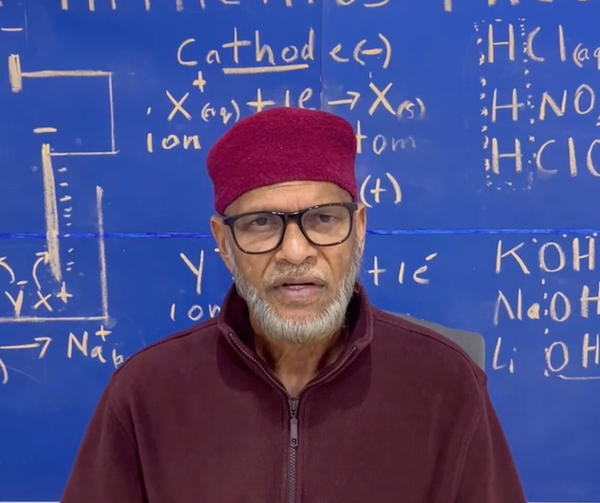
Prof. Hind Al-Abadleh: Reuniting faith and the environment
By Pauline Finch
The first time I saw Anglicans and Muslims interacting, even collaborating for one another’s mutual benefit, wasn’t in real life. No, you guessed it; I was watching “Little Mosque on the Prairie.” But amid the laughter and goofiness of it all, there were sparks of wisdom and a shared passion for life that have stayed with me ever since.
Perhaps it’s a great leap of logic and faith to move from a TV program to a large rambling red-brick church on a busy corner in downtown Kitchener, where St. John the Evangelist stands. Like so many 19th-century inner city churches, it’s much bigger than the active, yet numerically declining congregation it now holds. Like the struggling Anglicans of the fictitious small town of Mercy, however, St. John’s members are curious, proactive, open to change, and deeply aware of the increasingly diverse cultures of the neighbourhood in which they worship every Sunday.
In striking contrast to a past generation or two, as 21st-century Christians, they care more about exchanging real conversation and ideas — not just polite pleasantries — with people of other faiths. Many wish there were more opportunities to do so, not only around issues of religion, but around common causes that affect us all.
When I recently spotted a fascinating article by Wilfrid Laurier University professor, Dr. Hind Al-Abadleh (Scientist Views Climate Change through the Lens of Faith – CIC Friday Magazine, Jan. 8, 2010 – reprinted from www.IQRA.ca Dec. 9, 2009) one of those connecting “aha moments” happened.
As a member of St. John’s newly formed environmental group Green Passion, one of my tasks for 2010 was to find an Earth Sunday speaker (unfortunately, David Suzuki wasn’t available…) But as I read further into what Hind Al-Abadleh had to say about the God-given mandate of humanity to care for this planet as stewards, rather than selfishly consume it into oblivion, I realized that the perfect guest speaker was right on our doorstep, in Kitchener’s twin city of Waterloo.
When the other Green Passion members read the same article, we were unanimous. Our anticipation grew by leaps and bounds when she said yes! After some sorting back and forth with dates, May 9 – Mother’s Day — became the final choice. If we’d been asked to plan a worship event simultaneously encompassing motherhood, thanksgiving for Earth’s abundance, stewardship of our natural environment, and interfaith dialogue, the response might have been, “impossible … too much all at once!” But on May 9, the seemingly impossible happened with ease, right from the moment Dr. Al-Abadleh and her family (mom Leila, sister Iman, brother Mohamed) joined us for a 10 a.m. service called Matins.
Not only were we marking the international celebration of Mother’s Day; it was also the traditional Anglican observance of Rogation Sunday (when newly-planted crops are blessed and prayed for), our congregation’s chosen observance of Earth Day, and the first occasion in long memory when the sermon was presented by a member of our sister faith of Islam. Amazingly, Dr. Al-Abadleh covered these vast but related subject areas with wisdom, understanding, conviction and grace, illuminating her passion for environmental care with profound and inspiring verses from the Qur’an
As a professor of environmental chemistry at Wilfrid Laurier University, she deals on a daily basis with the accumulated physical effects of human influence (both positive and negative) on our planet’s atmosphere, water systems and land-masses. Sadly, it’s the negative evidence that continually reminds us what a huge price we’ve paid for our material wealth and high-consumption lifestyles.
Even as she spoke that day, crude oil continued to gush into the Gulf of Mexico from a sunken deep-sea drilling platform whose poorly regulated pollution “safeguards” had failed miserably. And we know that this won’t be the last such incident. As I write now, ten days later, oil continues to hemorrhage into the sea, ravaging this sensitive marine ecosystem for decades to come.
In the face of steadily worsening news about climate change, oil spills and shrinking natural resources, one can feel overwhelmed and powerless, but Dr. Al-Abadleh’s vision is about connecting faith and facts to make positive change, even if just one small step at a time – and you don’t have to be a professional scientist to do it.
Inspired by environmentalist Dr. David Suzuki and numerous references to earth-stewardship found in the Qur’an, she has devoted much of her personal and professional life to showing how science and religion can work together at the grassroots level for the healing and preservation of Earth’s endangered environment.
The Qur’an, she noted, repeatedly points out that we are not masters of creation; we were not given a divine entitlement to subdue, exploit, or consume at will everything the earth provides. Rather, we humans are God’s stewards, collectively responsible for maintaining ecological balance in the created world.
In fact, everything around us is a sign of God’s ongoing creative presence, to which we should respond by giving thanks and consuming in moderation. But when we ignore that core principle by greedily seeking excess rather than sufficiency, creation is thrown out of balance, along with our relationship to God. Using different images and contexts, Judaism, Christianity and other world faiths also express the vital importance of good stewardship, but perhaps (in my comparative experience, at least) nowhere is it phrased more explicitly, poetically, or frequently than in the Qur’an.
Dr. Al-Abadleh pointed out that the Qur’an is especially forthright in teaching humans how to act upon their natural feelings of awe and wonder in the face of cosmic phenomena and the sheer beauty of our planet. But we must “see” these myriad signs of God’s presence with more than physical eyes; we must also follow through in acts of faith, with an attitude of respect and reverence for all living things and the seemingly inanimate materials that sustain life. And in this, as God told Prophet Muhammad (peace be upon him) lies true righteousness for all “the children of Adam.”
It was a point well taken, judging by the rapt attention coming from pews of devout Anglicans in just one Kitchener church, who in microcosm reflected the genuine concern and commitment of our Christian denomination worldwide.
As we moved into an informal question-and-answer session over refreshments in the church hall, our guest speaker was surrounded by displays about recycling, alternate energy (even a working solar collector), green-roof architecture, climate change and –most importantly – people. Of the several dozen who stayed to learn more, a number were actually retired scientists and technicians, which made the dialogue with Dr. Al-Abadleh even more exciting. But the best question of all was, “when can you come back?”
#
Pauline Finch is an occasional contributor to the Friday Magazine (Canadian Islamic Congress) and a member of St. John the Evangelist Anglican Church in Kitchener, Ont. where she helped found the faith-based environmental working group, Green Passion. She graduated from Huron College, London Ont. in 2008 with a Master of Divinity degree and is interested in inter-faith dialogue and experiences. Source: www.CanadianIslamiccongress.com Friday Magazine
Toronto Faith Communities Respond to the Environmental Challenge
(March 11, 2010) – People of faith came together on Sunday, March 7th at the Green Awakening/Greening Sacred Spaces Annual Leaders Forum to discuss the biggest challenge to the welfare of life on earth – the destruction of the natural environment.
“Care for the environment is considered to be the same as care for oneself as the idea of the separation of the two is considered to be a form of ignorance,” noted Sensei Taigen Henderson of the Toronto Zen Centre during the interfaith panel discussion.
Hosted this year by Eastminster United Church on Danforth Avenue in Toronto, the forum included 5 practical workshops and an interfaith panel.
The event was sponsored by the Green Awakening Network and Faith and the Common Good through its Greening Sacred Spaces initiative.
“The idea of balance is important in the Islamic faith,” Dr. Hind Al-Abadleh, an assistant professor of chemistry at Wilfred Laurier University told the audience. “The verses of the Qur’an could be interpreted in light of our scientific understanding of how ecosystems work to suggest the inherent interconnectedness of natural elements.”
Mardi Tindal, moderator of the United Church of Canada told participants that “God invites us into wholeness of soul, community and creation.”
Alanna Mitchell, a Canadian author and journalist who writes about global science issues, moderated the interfaith panel and commented, following the presentations, that all speakers were using common language such as stewardship and interconnectedness.
The Green Awakening Network is a group of congregations of the United Church of Canada in the City of Toronto who have come together to share ideas and experiences, in partnership with others, on how to respond to the challenge of climate change and how to reduce our “carbon footprint.”
The forum concluded when Greening Sacred Spaces introduced their new solar energy program for religious buildings, and made their annual awards for the Hamilton, Kitchener-Waterloo and Toronto areas during a shared meal.
**Endnote: While the sage Honi was walking along a road, he saw a man planting a carob tree. Honi asked him, “How long will it take for this tree to bear fruit?” “Seventy years,” the man replied. Honi then asked, “Are you so healthy a man that you expect to live that length of time and eat its fruit?” The man answered, “I found a fruitful world because of my ancestors planted it for me. Likewise, I am planting for my children.” Talmud Ta’anit 23a (Presented by Rabbi Debra Landsberg, Faith Leader at Temple Emanu-El at the Forum).
A Catholic perspective on the theology of Tariq Ramadan
By Hind Al-Abadleh
On Friday, February 12, 2010, Professor Gregory Baum from the Centre Justice et Foi and McGill University delivered a public lecture at the Waterloo Lutheran Seminary at Wilfrid Laurier University in Waterloo, ON.
The title of his talk was Islam and Democracy: A Catholic Perspective on Reform and Renewal, which is based on his cr itical analysis of the scholarly work of Professor Tariq Ramadan.
Professor Baum based his lecture on his latest book, The Theology of Tariq Ramadan: A Catholic Perspective.
The Reverend Dr. David Pfrimmer welcomed the attendees to the lecture and invited Dr. Scott Kline from St. Jerome’s University (a public Catholic university affiliated with
the University of Waterloo) to introduce the speaker.
Professor Baum started his talk by saying that his interest in Ramadan’s work started when he recognized the high unemployment rate among Muslims in Montreal compared to other faith groups.
He was troubled by this finding and was “deeply hurt” by the discrimination and prejudice that Muslims face.
He said that the news, press and TV coverage against Muslims have negative effect on their economic status.
Stemming from his sense of “solidarity with Muslims”, Professor Baum associated himself with Presence Musulmane in Montreal, which is a group of Muslim citizens who follow the ideas of Tariq Ramadan.
Professor Baum took on the task of reading Ramadan’s books and articles, watch his TV interviews, and listen to his lectures when Ramadan visited Montreal.
He also read the published work of Ramadan’s critics.
Professor Baum concluded that those who criticize Ramadan have not read his scholarly works.
Critics misquote Ramadan often by taking his ideas out of context.
Hence, Baum devoted his latest book as a defense of Ramadan.
Professor Baum said that religion in general is challenged by modernity that emphasizes concepts such as human rights, democracy, freedom of religion, and freedom of press.
He said that Catholics in the 19th century rejected these ideas and demanded of believers to be faithful to the king or prince.
Such encounters forced Catholic thinkers to re-read their Scriptures in light of the reality the believers are faced with.
He said that Muslims struggle now-a-days is similar to what Catholics went through.
This struggle started by the end of the 19th century, when Jamal Al-Afghani was openly critical of the Ottoman empire’s policies and called for reform.
Professor Baum said that Professor Ramadan locates himself within this reform movement.
Ramadan identifies himself as a Western Muslim who concerns himself with how to be a faithful and responsible citizen at the same time.
Ramadan does that by emphasizing the universal message of the Quran, which confirms and corrects previous revelations throughout human history.
Ramadan emphasizes that revelation and reason are in harmony.
Ramadan defines “fitra” in the Quran as the orientation of humans towards the Divine, which originates from the “breath of God” that completed the creation of humans.
This “breath of God” remains in people and with people, and using their intelligence, they will be able to recognize good and evil.
Professor Baum said that when he reads Ramadan’s definition of fitra, he is reminded of early Christian theology that the Grace of God is in all humanity.
Professor Baum then moved to the topic of how Ramadan is encouraging Muslim to use the universal message of Quran to interpret Sharia, by using certain interpretive principles:
1) taking into account the context in which verses were revealed
2) taking into account present context when interpreting passages of the Quran
3) respecting the laws of the land and contracts that Muslims make when they go through the process of visiting or immigrating to western countries.
Professor Ramadan also calls on Western Muslims to cease thinking of themselves as minorities by emphasizing that they can remain faithful to their traditions and also integrate in the wider society.
This is similar to Jewish communities who are perfectly integrated and also able to preserve their religious identity and traditions.
Professor Baum also noticed that arguments made by Islamic extremists are similar to those by Catholic extremists.
It is based on literal readings of the scriptures and interpretations that help their political agendas.
When it comes to religious pluralism, Professor Baum noted that the Quran is more in favor of religious pluralism than Christian scriptures.
He invited Christians to reread their books and look deeply for verses that promote religious pluralism.
Professor Baum also noted Ramadan’s analysis of the status of women in Muslim communities.
He noted that Ramadan defends the freedom of choice for women when it comes to the issue of the veil.
It should not be the State or the Community who impose the veil on women.
Professor Baum clearly said that he supports Ramadan in his defense of women’s choices.
He noted that the issue of imposing the veil is similar in Catholicism, where the Sisters dress code in Churches has to be approved by a “bunch of guys”.
Professor Baum concluded the lecture by saying that Ramadan is an academic and a “pastor”, who concerns himself with ordinary Muslim people (especially Western Muslims), and wants to help them recognize and understand their religion.
During the Q&A session, Prof. Baum was asked of his view on inter-religious dialogue.
He said that he supports them when their objective is to find common ground, and not to decide who’s right and who’s wrong.
He added that these dialogues are important when effort is made to understand the other and discover their views and insights.
He said that we should approach interfaith dialogue as a “exercise of love” in the sense that we make the effort to put ourselves in the shoes of the other to know them better.
Such interaction imposes on those involved to look at one’s own tradition with a different eye and encourages one to re-read it and re-posses it.
Professor Baum ended by saying that the question on his mind now is can there be a dialogue between believers and non-believers?
He believes that yes, it could happen, especially when (1) it occurs between those who respect religion for its positive influence on people, (2) the objective is not on who’s right or wrong, and (3) it is on issues related to the ones that touch us all that include ecology, peace, and justice.
Professor Baum sees this dialogue needed for establishing the “ethical foundation of modern society”.
The organizers thanked the speaker and presented him with a gift.
Professor Baum was available after the talk to briefly meet those who attended and wanted to thank him in person. He signed my copy of his latest book.
Overall, Professor Baum was a gracious and inspirational speaker whose positive energy was felt by all who attended.
He emphasized “religious solidarity” many times in his talk. I feel lucky to have met him in person and heard directly from him his analysis of Ramadan’s work.
Professor Baum’s lecture was taped and it will be uploaded on the Seminary’s website for people to download.
The link is: http://www.seminary.wlu.ca/wednesdaylecture.php
Through religious lens: combating climate change
By Hind Al-Abadleh
(December 10, 2009) – As world leaders gather in Copenhagen this week (Dec 7-18, 2009) to negotiate reductions in emissions of gases causing climate change, citizens of the world should continue the task of examining their value systems that define their relationship with the Natural world. For Muslims who derive their value system from the Quran and traditions of Prophet Mohammed, peace be on him, climate change should be a priority of high importance along with social justice and fighting illiteracy, poverty, and disease.
An issue like climate change is backed up by thousands of scientific studies on the causes and potential impacts on the planet and the species that inhabit it. Hence, such a global issue should occupy some of our daily thoughts, especially the role that we should play as responsible and scientifically-literate citizens in reducing emissions from our lifestyles.
As a Muslim scientist who is involved in teaching and research in atmospheric chemistry, I contemplate the following question: With all the science behind climate change, is there room for religion to say anything about it?
I think to answer the question, one has to understand the type of knowledge that scientific studies are providing regarding the contribution of human activities to climate change, and the religious teachings that shed light on the relationship between humans and the natural world.
Global climate science is based on (a) measurements of greenhouse gas emissions and Earth’s surface temperature, (b) experiments on the chemistry of these gases with each other and other constituents in the atmosphere, and (3) computer modelling of the chemistry and physics of the complex constituents in the atmosphere.
The thousands of scientists who believe that climate change is happening acknowledge the following facts: (a) carbon dioxide (CO2) leads greenhouses gases [that include natural gas (methane), ozone, chlorofluorocarbons and laughing gas (nitrous oxide)] in terms of the extra warming they have produced, (b) while CO2 releases from human activities are only 4% of that produced by Nature, CO2 concentrations are increasing indicating a net build-up of this gas in the atmosphere, (c) according to the 2007 report by the U. N. Intergovernmental Panel of Climate Change (1), global warming observed in the past 100 years is very likely (80-90%) due to CO2 releases by human activities, because natural global warming as large as 0.5 degree Celsius appear once or twice a millennium, (d) the uncertainty in the predictions of models used to predict future climate stems mainly from their mathematical treatment of clouds and particulate matter. To improve the predictive power of climate models, many research groups in North America and Europe are working to understand the science behind cloud formation and lifetime, and the contribution of natural and anthropogenic atmospheric particles to climate change.
Science of climate change helps us understand the how and why questions of human activities’ negative impacts on the natural world. These activities are mainly driven by the desire to grow “the economy’. This is anything but new as we (humans) had to deal with acid rain and ozone layer depletion after the industrial revolution, and are still dealing with different forms of air and water pollution in different parts of the globe.
While we live in an era of unprecedented scientific discoveries and technological advancements, we pretty much have ignored an important parameter in our selfish scientific endeavour, which is the potential negative impact of our activities BEFORE we conduct them in the name of improving our economies.
Many scientists believe that what led us to this stage of environmental degradation is a view to Nature as an infinite resource of raw materials needed for our economic growth, and as an infinite-size dumpster for the waste we generate in the process. People across the board have subscribed to this view. Such an irresponsible view of Nature by the human race on this planet is not only disturbing the cyclical and balanced interactions among all elements of Nature, but also is threatening the continuation of life in its different forms on this planet.
Hence, we are at a stage in our collective human history where self-examination of one’s value system is needed, particularly in defining our relation as a species with the rest of elements in Nature. To take on this task, I see religious teachings playing a crucial role.
For Muslims, the Quran is the word of the One God (Allah) and is considered one of the sources of knowledge that defines human relationship with Nature. Prominent scholars such as Dr. Seyyed Hossein Nasr (2) and Dr. Yusuf Al-Qaradawi (3) have written extensively on meanings of the verses in the Quran that shed light on this topic. It is interesting to note that these verses address the human race in general, believers and non-believers, and hence the message in these verses is a universal message (4).
For example, elements of nature that include living and inanimate creation are referred to as “signs” of God’s existence: “On Earth there are signs for those with sure faith; and in yourselves too. Do you not see?” Quran (51:20, 21).
God describes that animals form nations and communities like humans: “All the creatures that crawl on the Earth and those that fly with their wings are communities like yourselves” (Quran 6: 38).
God also says that all natural elements are in a continuous state of worship: “Do you not realize [Prophet] that everything in the heavens and earth submits to God: the sun, the moon, the stars, the mountains, the trees, and the animals? So do many human beings” (Quran 22:18). “The seven heavens and the Earth and everyone in them glorify Him. There is not a single thing that does not celebrate His praise, though you do not understand their praise: He is most forbearing, most forgiving” (Quran 17:44).
The state in which God has created the universe is also described in the Quran: “He (God) has raised up the sky. He has set the balance” (Quran 55:7), which in light of our scientific understanding of how the ecosystem work, the word “balance” suggests inherit interconnectedness of natural elements.
So, where does the human race fit in the picture? The following Quranic verse clearly answers that question: “It is He (God) who has made you (people of Adam) khalef al-Ard (successors, stewards, vicegerents on the Earth)” (Quran, 6:165). Muslims understand that this appointment by God comes with great responsibility and accountability (5).
As God’s vicegerents on Earth, generations of humans are guardians of the natural world and should work hard to keep it in a balanced state: “He (God) has set the balance so that you may not exceed in the balance. Weigh with justice and do not fall short in the balance” (Quran 55:7-9).
The accountability principle that governs human beings relation with the natural world is understood from this verse: “Corruption has flourished on land and sea as a result of people’s actions and He will make them taste the consequences of some of their own actions so that they may turn back” (Quran 30:41). The word “corruption” (fassad in Arabic) has been interpreted by many scholars to include environmental degradation (2-4).
In summary, Islamic teachings provide an ethical worldview of Nature and extends an invitation to believers and non-believers alike to reflect on natural phenomena, and to safeguard natural elements as an invaluable trust so that they may avoid disturbing the inherent balanced state of the planet. Humans should strive and excel to build a sustainable and responsible civilization that is in harmony with the rest of natural elements.
Muslims in particular have a greater responsibility towards Nature as the bearers of the Islamic message. They ought to revive their understanding of their role on Earth as trustees by acting on the Quranic and Prophetic traditions that encourage them to lead a responsible and environmentally-friendly lifestyle in this world (7). I pray that God will make us from among those who listen, contemplate, and follow the best of what is said.
References and additional resources:
(1) UN IPCC: http://www.ipcc.ch/
(2) The Islamic perspective on the environmental crisis: Seyyed Hossein Nasr in Conversation with Muzaffar Iqbal. Islam and Science (Review), Jun 22, 2007. Accessed through www.thefreelibrary.com
(3) Dr. Yusuf Al-Qaradawi, Caring for the Environment in Islamic Shariaa (Arabic), Dar Al-Shorouk (www.shorouk.com), Cairo, 2nd edition, 2006.
(4) Dr. Tariq Ramadan, Radical Reform: Islamic Ethics and Liberation, Oxford University Press, 2009.
(5) Fazlun M Khalid, Islam and the Environment in Encyclopaedia of Global Environmental Change, Peter Timmerman (Eds), vol. 5 (2002), John Wiley & Sons, pp 332-339.
(6) M.A.S. Abdel Haleem, The Qur’an: A new translation, Oxford University Press, 2nd ed., 2005.
(7) Muslim Green Guide to Reducing Climate Change, LifeMakers UK and Islamic Foundation for Ecology and Environmental Sciences (www.ifees.org), 2008.
(8) Elizabeth May and Zoe Caron, Global Warming for Dummies, 2008 (Note: The science in this book is based on the 2007 IPCC report and it was reviewed by scientists who were on the IPCC panel. It is full of ideas to implement in our daily activities to reduce our greenhouse emissions).
*Dr. Hind Al-Abadleh is an Assistant Professor of Chemistry at Wilfrid Laurier University, and teaches courses on environmental chemistry. She is interested in studying how religion can motivate people of faith to changing their practices to more environmentally-friendly ones. She could be reached at halabadleh@wlu.ca
Environmentally-friendly Practices in Ramadan, a Religious Duty
By Hind Al-Abadleh
(AUGUST 30, 2009) – Every year, Muslims around the world observe the fasting in the month of Ramadan (9th month in the Islamic calendar) as it is one of the five pillars of the religion of Islam.
Numerous articles have been written on the relative magnitude of reward that a believer would receive for all acts of worship, charity and kindness done in this month relative to other months, provided that these acts are performed with the proper and sincere intention of pleasing God alone.
One of the famous sayings of Prophet Muhammad (PBUH) is narrated by Abu Huraira, in which he said, “Allah said, ‘All the deeds of Adam’s sons (people) are for them, except fasting which is for Me, and I will give the reward for it.’ (Bukhari Volume 3, Book 31, Number 128).
Muslims recognize that to qualify for the best reward from God in this holly month, observing the fasting in Ramadan cannot be as mechanical as abstaining from eating and drinking.
The Prophetic traditions are full of examples on how little acts with negative impacts on surroundings and people’s feelings, or acts done with impure intentions result in disqualifying a Muslim for the reward of fasting, even if he or she has stopped eating and drinking during the day.
With that in mind, I believe that taking the time during Ramadan to remember and act upon our obligation as people of faith toward the environment we live in is as important as all other extra acts of worship we perform enthusiastically and exclusively in Ramadan.
One example of responsible behaviour towards the environment is waste reduction and recycling.
These two environmentally-friendly practices are most relevant to community iftars (i.e. meal to break the fast) and potlucks that take place on a daily or weekly basis in many mosques and Islamic centres across the country.
The Muslim community in Canada is blessed by the abundance of clean food and safe water, and the diversity of this community is reflected in the numerous cultural cuisines that one would clearly see when attending such community gatherings.
Yet, how many times are we shocked by the amount of food that people help themselves to on a single plate to find out later that most of it ended up in the trash bin?
Any person with conscience would be astonished from such a scene because it’s happening during a month when we strive to be better Muslims and citizens, and also at a time when food banks are constantly encouraging donations to serve the poor and the homeless.
I think we need an attitude shift while approaching the food table in any community iftar from that of “I’m so ready to eat now after 12+ hours of fasting” to “I’m only taking this amount and I’ll eat it all”.
We also have to be aware that children are around us in these gatherings who are keen observers of how adults behave socially.
After all, everyone goes home later where one is careful not to throw food in the garbage, and discourage their kids from doing so.
As responsible Muslim adults, we have to lead by example, and not only by lecturing and warning of God’s punishment for the wasteful.
In other words, our understanding of the following Qur’anic verses needs to be put into practice: “Eat and drink the sustenance God has provided and do not cause corruption in the land” (Quran 2:60, ref. 1), and “They (the servants of the Lord of Mercy) are those who are neither wasteful nor niggardly when they spend, but keep to a just balance” (Qur’an 25:67, ref. 1)
Also, most municipalities across the country have implemented recycling programs.
The larger Canadian community is increasingly adopting environmentally-friendly practices, and Muslims should be no exception.
For Muslims in particular, recycling should be regarded as the indirect way of avoiding the exploitation of natural resources as we’re ordered to in this verse: “Do not cause corruption (fasad) in the land” (Quran 2:11, ref. 1).
The interpretation of the word fasad encompasses creating imbalances in the natural world due to human consumption (ref. 2).
Hence, recycling the plastic and styro-foam cutlery used in community iftars should be a priority for each responsible adult Muslim.
We all should encourage the management of mosques and Islamic centres to adopt effective recycling programs during Ramadan and beyond.
According to the 2008 Greening Sacred Spaces report published online by Faith and the Common Good (ref. 3), the Islamic Foundation of Toronto switched to using biodegradable cutlery at events.
I was present at an iftar program held last year at the International Muslims Organization of Toronto where school-age volunteers were present at multiple recycling bins and asked people to separate food for composting and throw plastic and styro-foam in separate bins.
One also should emphasize here that such positive practices of civilized and responsible believers would be noticed by our non-Muslim friends whom we invite to come along to such gatherings.
In conclusion, I pray that the spirit of Ramadan would be a positive force for change in all of us at the personal and communal levels. Ameen.
References and Useful resources:
1- M.A.S. Abdel Haleem, The Qur’an: A new translation, Oxford University Press, 2nd ed., 2005.
2- Water Management in Islam, http://www.idrc.ca/openebooks/924-0/
3- Greening in Faith Communities, Case Studies on Ten Community Profiles. Greening Sacred Spaces 2008, http://www.faith-commongood.net/
4- website of the UK-based Islamic Foundation for Ecology and Environmental Sciences (www.ifees.org), which regularly publishes periodicals on the relationship between the teachings of Islam and environmentally-friendly practices.
Dr. Hind Al-Abadleh is an Assistant Professor of Chemistry at Wilfrid Laurier University, and teaches courses on environmental chemistry. She is interested in studying how religion can motivate people of faith to changing their practices to more environmentally-friendly ones. She could be reached at halabadleh@wlu.ca
“Where is home, Ma’am?” – Reflections of a new Canadian

By Hind Al-Abadleh
(August 22, 2009) – I was returning from a short road trip to the U.S. to attend a friend’s wedding.
This is a routine question that the border officer asks every person presenting a Canadian passport to enter Canada.
However, answering this question made me experience flashes of memories and intense mixed emotions that have lasted with me till the day I’m writing this article, a week after he said it.
I immigrated to Canada four years ago, and just recently celebrated my Canadian citizenship.
This past trip to the U.S. was my first carrying the Canadian passport.
I immigrated as a skilled worker, and so I feel about my Canadian citizenship the same way I feel about my PhD – I’ve worked hard to earn it because Canada’s immigration laws welcome highly skilled immigrants.
Hence, I feel entitled to be treated equally in the same way as other fellow citizens who were born in Canada. After all, no one chooses where to be born, but I chose Canada as a country to settle in and now call it home.
I always think about the question of “homeland” and “belonging to a place”.
I was born in one city (City 1) decided by my parents who had the luxury to choose where their offspring would be born.
I grew up from birth in another city (City 2) where I completed all my education till university.
I have childhood and youth memories in each of these cities.
So, I feel that I belong to each one and that I am entitled to what each city has to offer its residents.
I belong to City 1 because I was born there and it is my parents’ home city.
I belong to City 2 because of my memories, friends, and education.
But, as I was finishing university, neither of these cities had what I was longing for – to live with dignity, stability, and being valued by society because of my contribution and not my family name.
My family name (paternal and maternal) is very well-known and respected in both Cities 1 and 2.
When I used to visit City 1, I would be treated like a princess because of my family name.
I have cousins who even tell me that I would be hired as a Dean of Science if I ever decide to go back and settle in City 1 because I have both, the PhD and the reputable family name.
For City 2, both of my parents are known in society because they belong to the hardworking class of foreigners and contributed for over 35 years to the service and education sectors.
Yet, in my pursuit of happiness and peace of mind, both cities didn’t have what I was looking for.
City 1 lacks the political stability that most people living in Western countries take for granted, and City 2 lacks the laws that respects rights of foreigners to settle and retire without having to return to one’s “homeland”.
You may have noticed that I didn’t mention money because I would be employed in both cities in high paying jobs should I decide to live in either.
Some would say (and they do), that having money compensates for political instability and ill-treatment of foreigners.
I beg to differ, not because I think money is unimportant, but because I believe that as a human being, I deserve more than a paycheque at the end of the month.
I believe that the significance and value of human life is non-negotiable and should not be labelled with racial, religious or political terms that strip off its sacredness.
I also believe in the value of work and positive contribution to society and one’s own development, irrespective of one’s race or religion.
Hence, it was not satisfying for me to live in City 1 and feel that my life is constantly threatened and know that it’s my family name that is more important than my contribution in getting what I want.
It was also not satisfying for me to continue to live in City 2 after graduation knowing that my value as a working class foreigner will mean nothing when I am old enough to retire.
So, “Where is home, Ma’am?”, – for me it is the place where my humanity, dignity, choices and contributions are acknowledged, respected and valued.
So far, I have found in Canada what I was looking for, despite the sacrifices that all immigrants have to make for establishing a new life here.
It is exciting to be a new Canadian citizen and I thank my fellow citizens who congratulated and welcomed me to the larger Canadian family.
Dr. Hind Al-Abadleh is an Assistant Professor of Chemistry at Wilfrid Laurier University and became a Canadian Citizen in March 2009.
‘Arts, Culture and Religion – Friends or Foe?’
(August 3, 2009) – MuslimFest 2009 held an Open Discussion Forum on the role of Arts and Culture in a Muslim’s life during the festival that took place at the Living Arts Centre in Mississauga this past weekend.
The question up for discussion was ‘Arts, Culture and Religion – Friends or Foe?’
“The goal of the forum was to foster understanding and promote dialogue on this important topic,” said Afaun Mandol, an organizer of MuslimFest.
A small group of attendees took time out from the numerous events at the festival to join the forum which was skillfully moderated by educator, Michael Cassidy.
Cassidy began the forum by suggesting to the participants that the gathering should be an open circle for discussion instead of the traditional format of presentations followed by questions and answers
“The Forum should be a symbolic place within a gathering – a place to centre the experience and perception within each of us and a place to listen to our own questions” he said.
The participants actively engaged with the question and expressed the opinion that the ‘Friend or Foe’ description was far too simplistic – artistic and cultural expressions can be either a friend or foe depending on the intention and ethics behind the activity or product.
“We need to ask ourselves about the meaning of art, the objectives invested in it and what it offers us,” said panelist, Muneeb Nasir. “Arts imbued with purposefulness and ethics should bring us closer to God.
All participants agreed to challenge one another to remove the prefix, ‘Islamic’, from art or music to see how joining the larger arena feels- does Islamic art stand up with other art or music?
The creation of an ‘Islamic niche’ with the Arts and Culture field was also debated.
“It sounds comforting to those using it, like a safety, a protecting feature, keeping the wrong or bad out of the box – like a walled city,” said moderator, Michael Cassidy, challenging the group.
After the forum, panelist, Hind Al-Abadleh, commented that “one could see that people in our community are hungry for these healthy debates where one speaks their mind without hostility or intimidation.”
Elevating the Friday Sermon

By Hind Al-Abadleh
(June 18, 2009) – For most Muslims, Friday is not only the last work day in a given week, but a much anticipated day when a visit to the masjid (mosque) for Friday prayers means spiritual re-charging and fulfillment of a religious obligation on believing men.
Yet, a growing number of Muslims who regularly attend Friday prayers and listen to the khutbas express their dissatisfaction with the abilities of traditionally trained Imams in addressing contemporary issues and challenges facing Muslim communities in Canada (Nasir, 2009).
Muslims from all walks of life listen attentively to topics presented during Friday sermons, which they hope to take home for implementation in their every day lives.
Naturally, Imams would choose topics that they are most comfortable with and which they feel are important.
Given the high expectations Muslims place on the position of the Imam, the topics he presents, and its relevance to their personal and communal lives, members of the community should be proactive in offering feedback and expertise to aid the Imam in accomplishing his weekly task.
We live in an era where almost every masjid in Canada has a website.
Muslims who attend Friday prayers should be given the opportunity to vote online on the topics of Friday sermons.
A detailed schedule of the topic, name of person to deliver the khutba (for masjids with rotating khateebs), and also references used to write the sermons can be used to engage the community at large in the process of preparing the Friday sermons.
I would also suggest that people who attend Friday prayers be encouraged to provide feedback on the sermons they hear and any suggestions for improvements in the future.
I think using masjids’ websites for that purpose will encourage inclusiveness of males and females in the community, especially the latter, since they rarely even see the person who delivers the sermons on Friday.
As a highly educated religious population in Canada, Muslim women and men should actively shift their attitudes from complaining to taking action and claiming ownership of the wide range of services their local mosques provide.
Topics presented in Friday sermons are no exception, and a “bottom-up” approach is needed for a more intellectually-fulfilling educational experience on Fridays.
References
Nasir, M. Our Imam Problem, IQRA, (May 22, 2009), http://iqra.ca/?p=68.
Acknowledgement
I would like to thank members of the Muslim Presence Reading Circle for stimulating discussion on the topic of this article.
Dr. Hind Al-Abadleh is an Assistant Professor of Chemistry at Wilfrid Laurier University. She could be reached at halabadleh@wlu.ca