Canada’s First Nations Leader Reaches Out to Muslims
(June 23, 2009) – One of Canada’s First Nations Elders and spiritual leaders, Dave Courchene Jr from the Anishnabe Nation, Eagle Clan, met with Imams and Muslim leaders in Toronto last Friday seeking to establish a relationship with Canada’s Muslims and to work for restoring sacredness in people’s lives.
“I believe that the biggest challenge that we have today is to understand the significance and importance of that spiritual reality that exists whether we accept or deny it in our lives,” Courchene told Muslim leaders.
“Spiritual people must be at the forefront to bring back sacredness in today’s world,” he added.
Dave Courchene Jr. is the visionary behind The Turtle Lodge, the First Nation’s Center for Learning and Healing in Sagkeeng, Manitoba, Canada.
Through the teachings of elders from across Canada that began more than 20 years ago, Courchene promotes traditional ways to health and well-being.
His knowledge of First Nations spiritual teachings has led him to travel around the world, including to the Middle East, Japan, the Philippines and South Korea.
In addition to briefing Muslim leaders about the First Nations spiritual beliefs, Courchene spoke extensively about their relationship to the Earth and the urgency for humanity to address the environmental crisis.
“We are damaging the environment, we are damaging our home. We need to derive a way to live as human beings,” he said.
“I pray that this will be the first step on the path towards mutual sharing, honoring, and solidarity between our Muslim communities and the First Nations of the Americas,” said Dawood Zwink, a community development worker with Scouts Canada.
“I hope that Muslims will grow to a better understanding and make a deeper contribution towards the urgently needed healing of the Earth,” Zwink added.
The Muslim leaders also pledged to support a day of fasting on October 10, 2009, (A Celebration of Giving) that was launched by the First Nations and the food bank in Winnipeg, Manitoba.
Dave Courchene said the initiative would encourage people to fast for one day, and to give themselves in service to others or the Earth in some way.
“By fasting, we are celebrating the value of giving, by not taking from the Earth for one day,” he said.
Those fasting are being encouraged to get sponsored to fast for the valued amount of food not being eaten that day, with all proceeds or food being donated to food bank.
Courchene also addressed a number of public sessions with the Muslim community in Toronto.
At a lecture to Muslims at the Islamic Institute of Toronto, he told the audience that the First Nations people share some similarities with Muslims.
“The rest of society has put labels on Muslims,” he said. “We have also been labeled the same way.”
He outlined the Native belief about a time that would come when the earth would enter into a change ushering in a new life that would prevent the destruction of the planet.
“The new life will be represented by many different cultures and somehow they would gather to share the uniqueness of each of their strengths and give teachings and knowledge that they have gathered from their cultures,” Courchene said.
Shaikh Ahmad Kutty, Senior Lecturer at the Islamic Institute of Toronto and a regular scholar with IslamOnline Live Fatwa session, commented that the core principles of native spirituality presented by David Courchene Jr, have similarities with some Islamic beliefs and resonated with him.
“You have spoken from your heart and you have touched our hearts,” Shaikh Ahmad Kutty said in thanking David Courchene for coming out to meet Muslims.
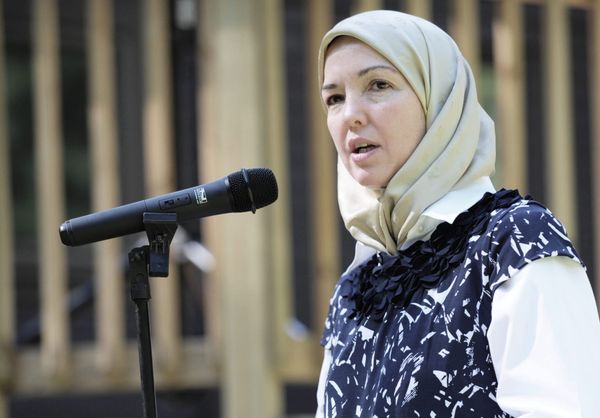
Dave Courchene Jr meeting with Muslim leaders
The Core of Concern for Earth Teachings
By Dawood Zwink
(June 21, 2009) – Muslims along with most of the world’s population are caught in the web of the dominant worldview. Critical values that characterize this worldview include a belief in the opportunity for social advancement, a belief that the goal of life is comfort and convenience, a persistent attitude of racism, and a faith in technology and progress. There is also a secular humanism that is anthropocentric in its assumptions.
The value of the quality of the natural environment, the value of maintaining biological diversity, or the inherent worth of species other than humans is a minority view. There is a pervasive sense of individualism and little assertion of the value of the community of humans, much less the “land community.”
Taken in its entirety, the increase in mankind’s strength has brought about a decisive, many-sided shift in the balance of strength between man and the earth. Nature, once a harsh and feared master [sic], now lies in subjection, and needs protection against man’s powers. Yet because man, no matter what intellectual and technical heights he may scale, remains embedded in nature, the balance has shifted against him, too, and the threat that he poses to the earth is a threat to him as well. – Jonathan Schell, The Fate of the Earth (1982)
The work called cultivating Earth awareness or ecological consciousness involves becoming more aware of the actuality of the creation, the rocks, wolves, trees, and rivers – the cultivation of the insight that everything is connected. Cultivating Earth awareness is a process of learning to appreciate silence and solitude and rediscovering how to listen. It is learning how to be more receptive, trusting, holistic in perception, and is grounded in a vision of non exploitive science and technology. People can clarify their own intuitions, and can act from deep principles.
“The whole of creation, in its most natural state, is the most immediate expression of the order intended by the Transcendent. Here, in the universe of the laws of nature” and “rule of instinct,” everything is in itself already and eternally “Islamic” — submissive to and at peace with the Living One (al-Hayy), the Eternal (al-Qayyum), who grants life (al-Muhyi) and brings death (al-Mumit). Nature is a book abounding in signs (ayat) of this essential link with the Divine, the “natural faith,” this “faith within nature” that is chanted by the mountain and the desert, the tree and the bird: “Art thou not aware that it is God whose limitless glory all [creatures] that are in the heavens and on earth extol, even the birds as they spread out their wings? Each [of them] knows indeed how to pray unto Him and to glorify Him; and God has full knowledge of all that they do”; “The seven heavens extol His limitless glory, and the earth, and all they contain; and there is not a single thing but extols His limitless glory and praise: but you [O men] fail to grasp the manner of their glorifying Him!” – Tariq Ramadan, Western Muslims and the Future of Islam (2004) p.12.
The logic of our (First Nations) traditions has developed over countless generations of experience. Following a communicative method of such antiquity and strength brings us closer to the core message of respect for the inter-relatedness of word, thought, belief and action. The meanings of our traditional teachings are embedded in the structure of the narrative as much as in any words one might write to explain them. (p.15)
The wisdom encoded in the indigenous cultures can provide answers to many questions: many seemingly intractable problems could be resolved by bringing traditional ideas and values back to life. Pre-contact indigenous societies developed regimes of conscience and justice that promoted the harmonious co-existence of humans and nature for hundreds of generations. As we move into a post-imperial age, the values central to those traditional cultures are the indigenous contribution to the reconstruction of a just and harmonious world. (p. 30)
The Windat Nation historian Georges Sioui provides a lucid summary of the basic values of traditional indigenous political and social thought:
With their awareness of the sacred relations that they, as humans, must help maintain between all beings, New World men and women dictate a philosophy for themselves in which the existence and survival of other beings, especially animals and plants, must not be endangered. They recognize and observe the laws and do not reduce the freedom of other creatures. In this way they ensure the protection of their most precious possession, their own freedom. (p. 46)
Justice is the achievement of balance in all relationships and the demonstration in both thought and action of respect for the dignity of each element in the circle of interdependency that forms our universe. (p. 67) In indigenous philosophies, power flows from respect for nature and the natural order. In the dominant Western philosophy, power derives from coercion and artifice – in effect, alienation from nature. (p.84)
Craig Carpenter, Kanien’kehaka Elder offers the following admonition: …consider Thomas Banyacya’s four words: “Stop, consider, change, and correct.” Stop what you are doing, Consider the effects of what you are doing. Is it upholding life on this land? Or is it destructive to the life on the land? If it is destructive, then change your value system and your actions. We are not supposed to be subduing the earth, treading it underfoot, vanquishing the earth and all its life. We are supposed to be taking care of this land and the life upon it. So it’s up to you to consider which side you are on…. I was sent all around the world, and I found Indians everywhere. They didn’t all have brown skin; they weren’t all what they call “red men.” But they had their sacred original instructions, and they were diligently trying to follow them. (Johnson, ed., The Book of Elders, 105) (p. 104) (All of the above passages are quotes taken from – Taiaiake Alfred, Peace, Power, Righteousness: An Indigenous Manifesto, 2009.)
With the help of God, we will recognize the truth and it will help us to remember, understand, and live the corresponding truth in our own wisdom, vision and responsibilities.
* The opening lines are drawn from Deep Ecology: Living as if Nature Mattered, – Bill Devall and George Sessions.