What Americans think about Muslims

February 7, 2010 by admin  
Filed under Featured, Opinion

daliamogahedBy Dalia Mogahed

The American people and their openness to Muslim communities will in many ways determine the success of US President Barack Obama’s global engagement initiative, which he launched on his inauguration day a year ago by calling for a “new way forward” with Muslims. Change will depend in large part on how Americans think, and it is therefore crucial to understand American perceptions of Muslims and Islam.

How much do Americans know about Islam and Muslims? What characteristics define Muslims in most Americans’ minds? And, perhaps most importantly, what factors make prejudice or tolerance more likely?

A new study released last week by the Gallup Center for Muslim Studies sheds light on these questions and many more. The following is what we discovered when we interviewed a thousand representative Americans on their perceptions of several faith communities, with in-depth analysis of their perceptions of Muslims and Islam.

Americans are more likely to admit harbouring prejudice toward Muslims than any other faith community that Gallup studied. Forty-three percent of Americans admit to having at least some prejudice toward Muslims. This is more than twice the number that expresses some prejudice toward Jews, Buddhists or Christians.

We also discovered that being prejudiced toward Jews makes a person more likely to express prejudice toward Muslims than any other factor studied. Of all the variables we looked at, from age to education to perceptions, the factor that was most strongly associated with anti-Muslim prejudice is not level of education, whether or not one knows a Muslim, or even one’s opinion of Islam-it is anti-Jewish prejudice. These results suggest that anti-Semitism and anti-Muslim sentiment are related phenomena, and that organisations fighting these social ills must work more closely together since they appear to be fighting for a common goal.

Frequent religious service attendance makes Americans half as likely to express extreme prejudice toward Muslims. For example, frequent church attendance makes someone less, not more likely to express prejudice toward Muslims.

The survey also revealed that prejudice, or the lack thereof, is more strongly associated with one’s opinion of Islam than with whether or not someone personally knows a Muslim. If someone does not know a Muslim personally, it does make him or her more likely to express extreme prejudice toward the group. But, perhaps surprisingly, knowing a Muslim does not increase the likelihood of a person expressing no prejudice.

What these results suggest is that knowing a Muslim may help soften extreme prejudice, but it is not enough to eliminate it.

Our survey results also tell us that American perceptions of what Muslims think are sometimes significantly different from what Muslims really do think. Roughly eight in ten Americans (81 per cent) believe that most Muslims do not value gender equality. However, according to Gallup research in Muslim-majority societies around the world, the majority of Muslims, including 85 per cent of Saudi Arabians and 89 per cent of Iranians, do believe that men and women should have equal legal rights.

Despite what may seem like negative results, the polls indicate that Americans’ views of Muslims and Islam have generally improved over the past two years. Moreover, roughly seven out of ten Americans also say that greater interaction between the West and Muslim communities is more of a benefit than a threat. The majority of Egyptians, Saudis and Indonesians share this view. In fact, overall, Muslim approval of the United States and its leadership is on the rise.

Ultimately, this study demonstrates that perceptions are not permanent, which is promising. But the public needs to be educated about Muslim beliefs. For example, Americans who believe that most Muslims support equal rights between men and women are twice as likely to express no prejudice toward them, indicating that we require a greater awareness of the fact that most Muslims worldwide support gender equality. We also know from the results of the study that prejudice is not isolated to one group, creating an opportunity for greater interfaith partnership to help address this issue.

The majority of both Americans and the world’s Muslims want engagement over isolation, a process that starts at home-through greater understanding of our own perceptions.

###

* Dalia Mogahed is Executive Director of the Gallup Center for Muslim Studies and co-author with John Esposito of Who Speaks for Islam? What a Billion Muslims Really Think (Gallup 2008). She also serves on the President’s Advisory Council on Faith-Based and Neighborhood Partnerships. This article first appeared in The Jerusalem Post and was written for the Common Ground News Service (CGNews). www.commongroundnews.org

What do the world’s 1 billion Muslims really think?

October 25, 2009 by admin  
Filed under Featured, News

muslimStar1By Muneeb Nasir

(October 27, 2009) – What do the world’s 1 billion Muslims really think?

A new documentary film based on a Gallup Poll report that seeks to answer this question, and carrying the title — Inside Islam: What a Billion Muslims Really Think — will have its Toronto premiere on Friday, October 30 at the CNE Queen Elizabeth Theatre.

The documentary reports on the survey’s surprising findings and implications, and brings it to life, interviewing researchers and others who conducted the public opinion polling.

As part of this groundbreaking six-year project, Gallup conducted fifty thousand interviews with residents in 35 predominantly Muslim nations, as well as smaller populations in Europe and the USA.

The broad extent of the polling has delivered findings for the world’s 1.4 billion Muslims with a plus or minus accuracy of 3%.

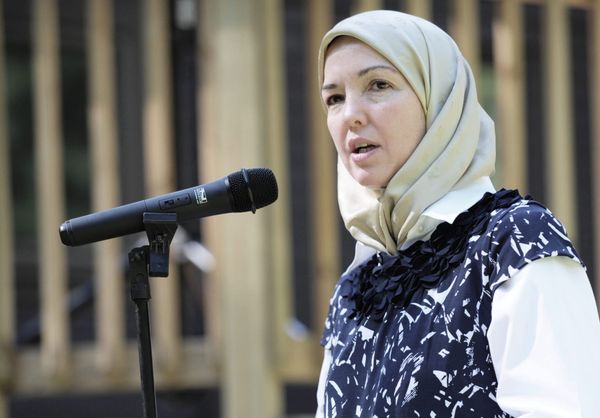
daliamogahed“The most important finding that we uncovered was that the clash or the conflict that does exist right now between the United States and Muslim majority countries is based on policies and not on a clash of principles,” Dalia Mogahed, executive director of the Gallup Center for Muslim Studies said at a special premiere of the film held at the ISNA continental convention in Washington earlier this year (July 3 – 6, 2009).

Mogahed, who appears in the documentary, is a member of U.S. President Barack Obama’s Council on Faith-Based and Neighborhood Partnership.

The film focuses on issues of gender justice, terrorism and democracy, and it challenges the notion that Muslims and the West are on a collision course.

Like the research, the film highlights a shared relationship that is based on facts, not fear.

Mogahed described several surprising findings in the study.

“We found Muslim admires much of the same things that Americans admire about ourselves,” she said.

On extremism, Mogahed said, Americans and Muslims are equally likely to find attacks on civilians as morally unjustifiable. On democracy, Mogahed pointed out that a large majority of Muslims would guarantee free speech if it was up to them to write a new constitution.

“When we asked Muslims what do you admire most about the West, the two most frequent responses were Western technology and democracy and liberty” Mogahed said.

“Even more remarkable is that when we asked a representative group of the American public, what is it that you admire most about western civilization, they said western democracy and western technology- amazing that the same responses were given by such a diverse group of people to an open ended question.”

Those polled also said that religious leaders should have no direct role in drafting such a constitution. On gender equity, a majority of Muslim men in most countries agreed, for instance, that women should be able to hold jobs.

In addition to Dalia Mogahed the film features John Esposito, University Professor, Georgetown University, Rami Khoury, Editor of the Daily Star (Beirut) and Kenneth Pollack, Director of Research, Saban Center for Middle East Policy at the Brookings Institute.

The Toronto premiere will be followed by a panel discussion with Alex Kronemer of Unity Productions Foundation, producers of the film and Imam Hamid Slimi, The President & Founder of Faith of Life Network, one of the sponsors along with Sheikh-IT Entertainment.

For more information on the premiere please visit: www.insideislam.ca

Obama’s Muslim Advisor to address ISNA Convention

June 18, 2009 by admin  
Filed under Featured, News

dm

(June 18, 2009) – Dalia Mogahed will be addressing American Muslims at the Annual Islamic Society of North America’s (ISNA) convention in Washington set to take place on July 3 – 6, in Washington, D.C.

Mogahed was appointed in April by U.S. President Barack Obama to serve on the Advisory Council on Faith-Based and Neighborhood Partnerships.

“I am very honored to be given this opportunity to serve my country in this way,” Mogahed, who will be Obama’s window into the Muslim American community, told AlArabiya.net.

In this position, Dalia Mogahed will be the first Muslim woman to sit on the council which advises the President about the opinions, values, perceptions, attitudes, and desires of more than 1 billion Muslims worldwide.

Mogahed will be a keynote speaker at ISNA’s Community Service Recognition Luncheon that is set to take place on Saturday, July 4.

Dalia Mogahed’s family came to the United States from Egypt when she was 5 years old. She is a naturalized U.S. citizen and lives in the Washington, DC area with her husband and two sons.

Ms. Mogahed has an undergraduate degree in chemical engineering, and a Master’s Degree in Business Administration (MBA) from the University of Pittsburg.

She served as a Senior Analyst at Gallup and Executive Director of the Gallup Center for Muslim Studies, a position in which she organized global research surveys to examine Muslims’ beliefs regarding education, religion, democracy, culture, financial prosperity, and the media.

In 2008, she co-authored woth John L. Esposito, ‘Who speaks on behalf of Islam? What a Billion Muslims Really Think,” the largest and most comprehensive study of the Muslim public opinion around the world.

When asked by Asharq Al-Awsat, the Arabic International Daily, about the type of Islam she is promoting, Dalia Mogahed said:

“I am on the council to serve my country by cooperating with other Americans to solve shared problems. I will draw heavily on the research Gallup has done on Muslim public opinion. I believe that the administration selected me to join this group because of this research. It means they are genuinely interested in understanding Muslim societies. At Gallup we believe that leaders make better decisions when those decisions are informed on the people. To solve the difficult problems facing the world today, ones that don’t stop at national boundaries or discriminate based on color or creed, leaders must hear what is on the minds of all people. President Obama and Muslims around the world tell us that they want to be partners in solving the world problems. Our research helps make this possible by giving ordinary people a voice at the table.” (A Talk with President Obama’s Advisor on Muslim Affairs, Dalia Mogahed, 07/05/2009, Asharq Al-Awsat)